

Bowing Before Assyria: Jehu’s Picture on the Black Obelisk
Bowing Before Assyria: Jehu’s Picture on the Black Obelisk


Critics frequently consign the Bible to the realm of fable, myth, and fantasy, populated with characters better suited for fiction than fact. These beliefs can be found in various formats, ranging from books and magazine articles to videos on YouTube and TikTok. Archaeology often provides an important corrective to this misunderstanding, reminding us that the people, places, and events of Scripture are grounded in real history. Among the most striking examples is the Black Obelisk of Shalmaneser III, which provides a unique contemporary image of an Israelite king and confirms the existence of one of the Bible’s most ruthless figures: Jehu, son of Nimshi (r. 842-813 B.C.). The infamous monarch appears not only in the biblical text but also in the annals of one of the ancient world’s greatest empires.
Jehu ruled the northern kingdom of Israel during the ninth century B.C. He served as a commander in the Israelite army (2 Kings 9:5) and was anointed by an unnamed prophet to avenge God’s servants who had died at the hand of the wicked queen Jezebel (vs. 7). In the bloodbath that followed, Jehu killed king Jehoram of Israel, king Ahaziah of Judah, Jezebel, and a large number of priests, prophets, and worshipers who had aligned themselves with Ahab (2 Kings 9:14-10:27).1 Following his grisly victory, Jehu established himself in the capital city of Samaria and ruled for nearly three decades.
Jehu was well known to the Assyrians, who mention him in at least four inscriptions. His name appears on a monumental bull discovered at the city of Nimrud (ancient Kalhu, or biblical Calah)2 and in the Marble Slab Inscription from the city of Aššur,3 both of which mention Jehu making a tribute payment to the Assyrian king Shalmaneser III. The Kurba’il Statue, discovered in the ruins of Fort Shalmaneser at Nimrud in 1961, refers to tribute payments from Jehu as well as from the Phoenician cities of Tyre and Sidon.4 The best-known, and perhaps most interesting, reference to the Israelite king appears on the Black Obelisk of Shalmaneser III.
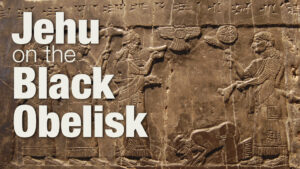
The beautifully preserved Black Obelisk dates to c. 828-827 B.C. and was discovered by Sir Austen Henry Layard at the ancient city of Calah in 1846. Each of its four sides contains five panels depicting foreign rulers bringing tribute payments to their Assyrian suzerain. One of these panels shows a bowing figure amid various officials, whom the accompanying inscription identifies as King Jehu. The text says, “I received the tribute of Jehu (Ia-ú-a) (the man) of Bīt-Ḫumrî: silver, gold, a golden bowl, a golden goblet, golden cups, golden buckets, tin, a staff of the king’s hand, (and) javelins.”5 Scholars debate whether the bowing figure is an envoy from Israel or a picture of Jehu himself (only a representation, as the king would not have personally travelled to Assyria). Nevertheless, many scholars believe this is indeed a depiction of the Israelite king, which is the only known contemporary portrait of any biblical monarch.


The Bible gives little information concerning Jehu’s reign and the specific conditions under which he became an Assyrian vassal. Scripture mentions that the rulers of both Israel and Judah often sought help and protection from human rulers rather than God (2 Kings 15:19-20; 17:3-4; Hosea 7:11; 8:9-10). It would appear Jehu followed the same path of political expediency as his peers.6 Like many other biblical kings, his existence is firmly supported by his appearance in the historical and archaeological records. The same could be said for roughly half of the rulers of Israel and Judah.
One potential problem raised by critics is that Assyrian sources refer to the king as belonging to the “house of Omri” (Assyrian Bīt-Ḫumrî), whereas the Bible seems to depict the two as having no familial connection—Jehu is a military commander who takes the throne in a coup. The Assyrians ordinarily referred to such usurpers as a “son of nobody”—in other words, a king who had no legitimate royal lineage. Such is the case for Hazael of Aram-Damascus, who is described as a usurper in both Assyrian records and the Bible (2 Kings 8:7-15).7 The natural—and unfortunately predictable—response from some critics regarding this potential discrepancy is that the Bible simply made an error. However, Assyriologist Lawson Younger notes, “The Assyrians often denoted countries by the name of the founder of the ruling dynasty at the time of their first acquaintance with it…regardless of which dynasty was currently in power.”8 Thus, this possible contradiction is easily resolved: the Assyrians referred to the Northern Kingdom as the “House of Omri” because they first contacted the kingdom during the reign of the Omride dynasty, despite Jehu having no connection to those rulers.
Not only does the Black Obelisk confirm Jehu’s existence, but numerous Assyrian inscriptions indicate his status as a vassal of the mighty Assyrian Empire. It also places him firmly within a historical framework consistent with both biblical and Assyrian chronology. Together with other Assyrian inscriptions, it confirms the political realities described in Scripture and reminds us that biblical figures were real people living in a real world. Jehu’s story is yet another reminder that Scripture’s claims stand up to scrutiny and that the Bible is rooted, not in myth, but in reality.
Endnotes
1 The Tel Dan Inscription indicates that Hazael of Damascus killed Jehoram and Ahaziah, while the biblical text credits Jehu with the deed. It appears that Hazael simply claimed responsibility for the deaths of the other two kings. It is a well-known fact that ancient rulers often exaggerated their accomplishments and took credit for the deeds of others. On this point, see Kenneth A. Kitchen (2003), On the Reliability of the Old Testament (Grand Rapids, MI: Eerdmans), p. 37.
2 K. Lawson Younger, Jr. (2000), “Annals: Calah Bulls (2.113C),” The Context of Scripture, ed. William W. Hallo and K. Lawson Younger (Leiden: Brill), 2:266-267.
3 K. Lawson Younger, Jr. (2000), “Annals: Marble Slab (2.113D),” The Context of Scripture, ed. William W. Hallo and K. Lawson Younger (Leiden: Brill), 2:267-268.
4 K. Lawson Younger, Jr. (2000), “Kurba’il Statue (2.113E),” The Context of Scripture, ed. William W. Hallo and K. Lawson Younger (Leiden: Brill), 2:268-269. See also A. Kirk Grayson (1996), Assyrian Rulers of the Early First Millennium BC II (858-745 BC) (Toronto: University of Toronto), pp. 58-61.
5 K. Lawson Younger, Jr. (2000), “Black Obelisk (2.113F),” The Context of Scripture, ed. William W. Hallo and K. Lawson Younger (Leiden: Brill), 2:270. The reference here is to the “house of Omri.”
6 Other famous incidents include Ahab’s treaty with the Arameans (1 Kings 20:31-34), Ahaz’s appeal to the Assyrian king Tiglath-pileser III (2 Kings 16:7-9), and Hezekiah’s attempts to secure military aid from Egypt (Isaiah 30:1-7; 31:1).
7 K. Lawson Younger, Jr. (2000), “Aššur Basalt Statue,” The Context of Scripture, ed. William W. Hallo and K. Lawson Younger (Leiden: Brill), 2:270.
8 Younger, “Annals: Calah Bulls,” 2:267 n.5.
Image Credit (Title Image): Wikimedia Commons photo by Osama Shukir Muhammed Amin FRCP(Glasg), CC BY-SA 4.0.
Wikimedia Commons photo by Osama Shukir Muhammed Amin FRCP(Glasg), CC BY-SA 4.0.

REPRODUCTION & DISCLAIMERS: We are happy to grant permission for this article to be reproduced in part or in its entirety, as long as our stipulations are observed
posted by Believer | 1:00 AM

0 Comments:
Post a Comment
<< Home