


The Gospel in Genesis (Part 2)
The Gospel in Genesis (Part 2)


In Genesis, as throughout the Old Testament, the Messiah is revealed not only in promises and prophecies, but also through real people, places, and events that serve as living illustrations of Someone much greater. These divinely arranged “pictures”—which we often call types, figures, and foreshadowings—subtly anticipate and illuminate the coming of Jesus Christ, the Savior of the world.
A Beloved Son Offered
Genesis 22 includes one of the most puzzling accounts in all of Scripture. God instructed his faithful servant Abraham, saying, “Take now your son, your only son Isaac, whom you love, and go to the land of Moriah, and offer him there as a burnt offering” (22:2). How could an all-good, all-loving God Who despises human sacrifice (Jeremiah 7:31; Leviticus 20:2-5; Deuteronomy 18:10) command Abraham to sacrifice his son?
Though this serious ethical question is answered more thoroughly in articles and videos on the Apologetics Press website (apologeticspress.org), let me briefly offer the following response here: (1) God never intended for Isaac to actually die at Abraham’s hand: God’s command was a “test,” as stated in verse one of the chapter (cf. Hebrews 11:17)—and God’s tests are meant to strengthen us, not cause us to sin (Exodus 20:20; cf. John 6:5-6; James 1:13). (2) As an omniscient God, He knew that He was going to step in and stop Abraham from ever actually killing Isaac. (3) Had Abraham literally sacrificed Isaac, he would have disobeyed God, since (a) this was a test, and (b) at the moment when Abraham was about to slay his son, “[T]he Angel of the Lord called to him from heaven and said, ‘Abraham, Abraham!… Do not lay your hand on the lad, or do anything to him’” (Genesis 22:11-12).
But why? Why did God test Abraham with the strangest and severest of commands? What could be more difficult to hear God say? What could be more difficult to do? Why is this baffling story in the Bible?
As with most of our “why” questions, the sovereign God of the Universe does not directly answer these for us (nor does He have to). Undoubtedly, His command to Abraham and the preservation of this account in Scripture serve multiple purposes (cf. Hebrews 11:17-19), whether we know of them or not. However, based upon the theme of Genesis, of the Bible as a whole, and the placement of this story directly between two specific Messianic promises (Genesis 21:12 and 22:18), surely this account serves primarily to foreshadow the coming of the Messiah—the sacrificed, beloved Son of God on Calvary.
When we step back and consider the details of Genesis 22, the parallels between Isaac and Jesus are too numerous—and too specific—to ignore.
- Isaac was a promised son (Genesis 17:19; 21:12), just as Jesus was the promised Son announced to Mary (Luke 1:30-33).
- Isaac’s birth required divine intervention, since Sarah was barren and beyond childbearing age (Genesis 11:30; 18:11-14), while Jesus was conceived miraculously in the virgin Mary (Isaiah 7:14; Matthew 1:21-23; Luke 1:34-35).
- Isaac is called Abraham’s “only” son (Genesis 22:2)—his unique, beloved son (cf. Hebrews 11:17; Greek monogenes)—just as Jesus is the uniquely begotten (monogenes) Son of God (John 3:16; Matthew 3:17).
- Abraham took wood for the burnt offering and “laid it on Isaac his son,” which Isaac carried for his own sacrifice up Mount Moriah (Genesis 22:6). Jesus carried His wooden cross toward Golgotha for His own sacrifice (John 19:17).
- As there is no hint of struggling on Isaac’s part in Genesis 22, it seems that he willingly submitted to his father’s will to be sacrificed. Jesus likewise declared that He laid down His life of His own accord (John 10:17-18).
- Abraham was willing to offer up his son (Genesis 22:9-12; Hebrews 11:17), and two thousand years later God “did not spare His own Son” (Romans 8:32).
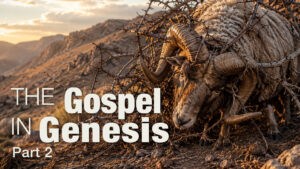
- A ram “just happened” to be provided as a substitute in Isaac’s place (Genesis 22:13), surely pointing forward to Jesus—the true Lamb of God (John 1:29)—Who gave His life as a ransom for many (Mark 10:45; 1 Peter 3:18).
- Abraham was willing to offer up Isaac—through whom God had promised to bless all nations—because he knew that God could raise him from the dead, “from which he also received him back as a type” (Hebrews 11:19, NASB)—as a symbolic representation. And what was this figurative event foreshadowing? Surely the triumphant resurrection of Jesus from the dead (1 Corinthians 15:20; Romans 4:24-25).
Individually, all of these similarities are striking. Together, they form a powerful picture: long before Calvary, God was quietly preaching the Gospel on Mount Moriah. There, a father learned what it meant to trust God with his son—so that one day the world might better understand what it meant for God to give His.
A Substitute Provided
The Bible’s picture of the penalty for sin and the cost of redemption goes back even earlier than Genesis 22. In fact, when sin entered the world in Genesis 3, we immediately—however so subtly—begin to see what salvation from sin will cost.
Some 2,000 years before Abraham named the place where God provided a substitute for Isaac, “The-LORD-Will-Provide (YHWH Yireh),” God provided in the Garden for Adam and Eve. Genesis 3:21 says, “[T]he LORD God made tunics of skin, and clothed them.” Implied in this short statement is the fact that God shed the blood of an animal for Adam and Eve.
The Creator of the Universe did not become perfectly holy (unable to fellowship sinners) and perfectly just (demanding punishment for sin) after making a covenant with Abraham or after giving Abraham’s descendants the Law of Moses. The spiritual truth that “blood…makes atonement for the soul” was not some new idea in Leviticus 17:11 (some 2,500 years after sin entered the world). The fundamental, divine truth that “without shedding of blood there is no remission” (Hebrews 9:22) has always been true.
Blood as Purification: In the Old Testament, blood was seen as the means of atonement. Leviticus 17:11 states, “For the life of the flesh is in the blood, and I have given it for you on the altar to make atonement for your souls” ESV.org.
Necessity of Bloodshedding: The verse affirms that forgiveness of sins could not occur without the shedding of blood. This principle underlies both the animal sacrifices of the Law and, ultimately, the sacrifice of Jesus Christ Bible Study Tools.
- Christ’s Superior Sacrifice: The surrounding verses (Hebrews 9:23–28) explain that Christ entered heaven itself, not just the earthly sanctuary, and offered Himself once for all to put away sin. This one-time sacrifice fulfills and surpasses the repeated animal sacrifices of the Law
Before Abraham sacrificed the substitutionary ram (Genesis 22); before Noah offered animal “burnt offerings on the altar” following the Flood that destroyed a wicked world (8:20-21); before Abel “brought of the firstborn of his flock and of their fat” as an offering to the LORD (4:4); God shed the blood of an animal in the Garden of Eden after Adam and Eve’s sin (3:21). Even before they fully understood the depth of their need, God graciously acted to provide for Adam and Eve. Indeed, such a substitutionary sacrifice seems implied in the animal covering of Genesis 3:21.
One cannot help but wonder what Adam and Eve were thinking as they watched an animal being killed because of their sin. On that day, the innocent life of an animal was taken because of their sin. God covered sinners with a substitute. From the first sin onward, forgiveness would not come cheaply—it would come covered in blood.
Today, God calls upon sinners to no longer walk in the lusts of the world, but to “put on the Lord Jesus Christ” (Romans 13:14). “For all of you who were baptized into Christ have clothed yourselves with Christ” (Galatians 3:27, NASB). Indeed, “the Lamb slain from the foundation of the world” (Revelation 13:8) graciously and mercifully makes sinners fit for God’s holy presence, having “washed their robes and made them white in the blood of the Lamb” (Revelation 7:14).
A Mediator Granting Access to Heaven
Genesis not only foreshadows the ultimate substitute for our sins, but it also provides a brief symbol of “the way” to God. In Genesis 28, the LORD reminded Jacob in a dream of the promise He made to his father Isaac and grandfather Abraham—“in you and in your seed all the families of the earth shall be blessed” (28:14). In this dream, “a ladder was set up on the earth, and its top reached to heaven; and there the angels of God were ascending and descending on it. And behold, the LORD stood above it” (28:12-13). When Jacob awoke astonished, saying, “How awesome is this place! This is none other than the house of God, and this is the gate of heaven! … And he called the name of the place Bethel” (28:16-17,19), meaning “house of God.”
Jacob had this dream as he was fleeing from his brother Esau, who was threatening to kill him for stealing Esau’s firstborn-blessing from their father (see 27:1-41). This theft followed Jacob’s exploitation of Esau, craftily leveraging Esau’s weariness and hunger to secure his birthright. Indeed, Jacob practiced deceit (27:35), and Esau responded after these two instances, saying, “Is he not rightly named Jacob? For he has supplanted me these two times. He took away my birthright, and now look, he has taken away my blessing!” (27:36).
Recalling these events, as well as the meaning of “Jacob” (“supplanter” or “deceiver”), is important as readers ponder a particular New Testament passage—John 1:43-51. Upon learning of the identity of Jesus, Philip the apostle finds his friend Nathanael to tell him: “We have found Him of whom Moses in the law, and also the prophets, wrote—Jesus of Nazareth, the son of Joseph.” When the initially skeptical Nathanael sees Jesus for the first time, Jesus says to him, “Behold, an Israelite in whom is no deceit!”
Unlike Jacob the “supplanter,” Nathanael was a thoroughly honest man. And when he received only a small piece of evidence for the Messiahship of Jesus, he immediately responded, “You are the Son of God! You are the King of Israel!” (John 1:49). To which Jesus responded: “You will see greater things than these…. Truly, truly, I say to you, you will see heaven opened, and the angels of God ascending and descending on the Son of Man” (1:50-51, ESV).
In Genesis 28, Jacob dreamed of a ladder bridging Earth and heaven, with angels of God ascending and descending, and the LORD standing above it. In John 1:51, the only explicit reference to Jacob’s dream outside Genesis 28, Jesus refers to the angels ascending and descending upon Him. He is the reality of Jacob’s dream! He is the bridge from Earth to heaven. He is the “one Mediator between God and men” (1 Timothy 2:5). He is “the way ” to the Father in heaven (John 14:6), and no one enters the Father’s presence except through Him (John 14:6). He is the “gate” into heaven (John 10:9, NIV). The Son of Man is the one and only access point for all peoples (Ephesians 2:18)! This truth was faintly foreshadowed in Jacob’s dream all the way back in Genesis 28.
Conclusion: The Gospel Foreshadowed in Genesis
As far back as Genesis, God was illustrating the way for sinful humans to somehow be found acceptable in God’s sight and have access into His perfectly pure presence. Atonement for sins and restored fellowship with our holy God cannot be “achieved” through mere confession or regret of sin. Access to God could never be “earned” by some meritorious—even herculean—effort on our part. We can’t force our way back to the Father.
Adam and Eve were deserving of death. We are deserving of death! (Romans 1:32). “[T]he wages of sin is death” (Romans 6:23). “But God, who is rich in mercy, because of His great love with which He loved us, even when we were dead in trespasses” (Ephesians 2:4-5) began to show us all the way back in Genesis—in the Garden of Eden, on Mount Moriah, and at Bethel—that He had a plan. A substitutionary Lamb would shed His blood and give His life in order to grant sinners access to God’s presence.
“[B]y the blood of Jesus” we can “draw near” to the Father (Hebrews 10:19-22)—the greatest truth the world has ever heard, foreshadowed all the way back in Genesis.
[Part three of this article will appear in next month’s issue of R&R.]

REPRODUCTION & DISCLAIMERS: We are happy to grant permission for this article to be reproduced in part or in its entirety, as long as our stipulations are observed.
posted by Believer | 1:00 AM

0 Comments:
Post a Comment
<< Home