


If the Flood Happened, How Did Animals Get Back to Australia?

If the Flood Happened, How Did Animals Get Back to Australia?


In 2 Peter 3:3-6, Peter warned his readers about a coming time in which individuals would scoff at the idea of the global biblical Flood. There is no doubt that we live in such a time. In fielding criticisms about a global Flood over the years, one argument is perhaps second-to-none in the frequency with which it is used by those who reject the Flood.1 If the Flood killed all pre-Flood land animals on the planet (not on the Ark), then how would land animals have traveled from the Ark on Ararat to remote areas that are only accessible by boat, like Australia, North America, or England? Here are six responses to that question that exonerate the biblical Flood model.
(1) A Knife That Cuts Both Ways
First, it should be mentioned that migration of animals to islands and remote places before the Flood may be an interesting question, but it is not a potential problem for the Creation model. Creationists argue that the world as God created it may have been something of a supercontinent (called Rodinia),2 potentially making travel to places that are now isolated continents or islands much easier. More likely, however, God created animals across the planet already in their designed habitats during Creation week.
After the Flood, however, how can animal dispersion be explained if God was not miraculously involved (which seems to be the implication of the text—e.g., Genesis 8:17-11:9). First, it must be conceded that, ironically, animals in such remote places are as much a problem for the evolutionary model as they are for the biblical Flood model. Whether evolution or Creation is true, animals exist in Australia, have been there for some time, and their arrival must be explained. Whatever explanation the evolutionist uses to explain the existence of animals in Australia may very well be an option for creationists as well.
(2) Closer Continents
It is also important to realize that, as with the evolutionary model, the Creation model has no problem with the idea of plate tectonics—the theory that the Earth’s crust is broken into large pieces that move relative to each other, diverging, converging, and transforming. Therefore, creationists also have no reason to reject the concept of Pangaea—the idea that all of today’s continents were once joined together in one massive continent. In fact, it was a biblical Flood believer by the name of Antonio Snider-Pellegrini who was among the first to suggest that the continents may have once been joined together into one continent3—long before Alfred Wegener, often credited with “continental drift,” was even born. Snider-Pellegrini believed that the Flood may have been the cause of the break-up of the original supercontinent and subsequent rapid movement of its pieces.4
The Pangaea concept may even be implied by the description of God’s activities given in Genesis 1:9. As is often the case, however, the problem creationists have with the conventional version of geologic history concerning Pangaea comes from the assumption of uniformitarianism—in this case, the idea that the pieces of the Earth’s crust have always been moving at the rate we observe today. While the continents are spreading on the order of centimeters per year today, if the Flood occurred, and “all the fountains of the great deep [presumably, the ocean floor] were opened” (Genesis 7:11), surely including volcanic and significant tectonic activity, the separation rate could certainly have been much quicker for a period of time. Evidence for just such an accelerated separation rate has been documented.5 By implication, immediately after the Flood, remote destinations like Australia, Antarctica, and India could have been much closer together than they are today, in keeping with Pangaea models, allowing migration to islands and remote continents before the continents were too far apart.
(3) Frozen Channels
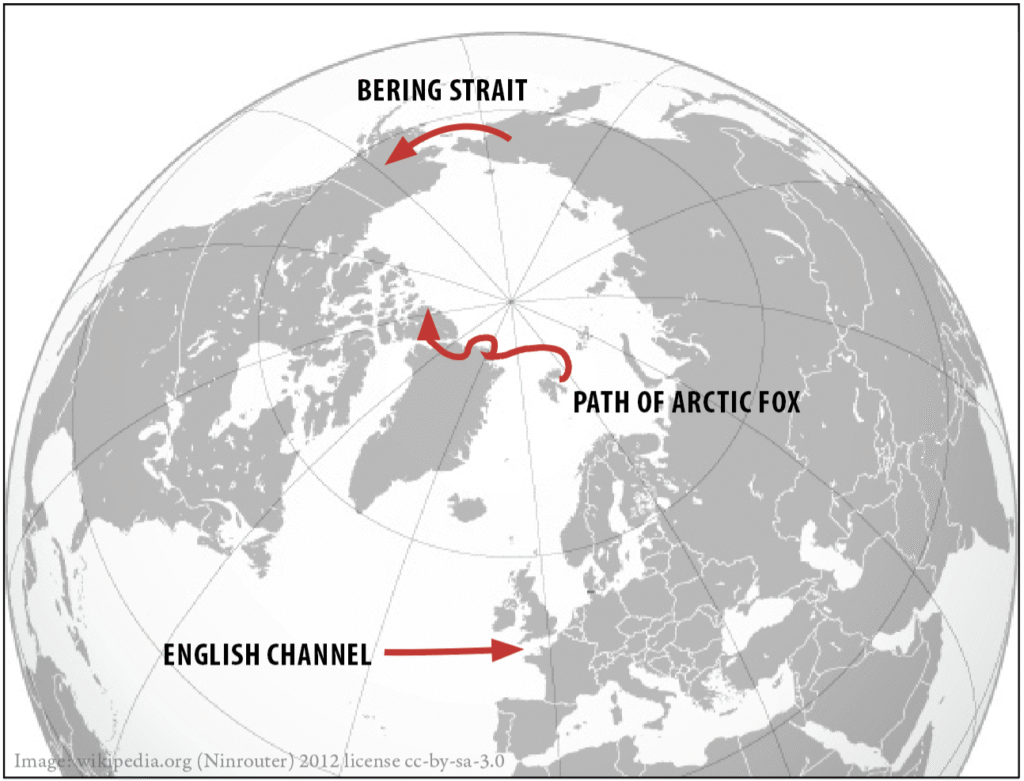
Other possibilities are also available which vindicate the biblical model. For example, according to the Flood model, a great Ice Age/Ice Advance commenced after the Flood,6 caused by warmer oceans (hence, greater precipitation) and increased volcanic activity (due to increased tectonic activity, causing cooler summers from increased volcanic aerosols and ash in the atmosphere). An Ice Age would have allowed animal migration from the Ark across frozen channels. The English Channel, as well as channels to Ireland, Iceland, and Greenland may have been frozen at the time. Significantly, a frozen channel from Russia to Alaska—the Bering Strait—would have allowed animal migration to North America. The water depth between the two is only 100-160 feet deep. With some 30% of the Earth’s continents covered with ice (as opposed to 10% today), the Earth’s sea level would have been significantly lowered making frozen channels common during the height of the Ice Age.
Ironically, in Origin of Species, glacier growth in the past was argued by Darwin to be how animals could have arrived in several remote places, including islands.7 As a modern example of animal movement across frozen channels, in 2018 scientists tracked an Arctic fox’s 76 day journey as it traveled from the far north Norway island group of Svalbard, across sea ice, the Greenland ice sheet, and Kane Basin to reach Ellesmere Island, Canada.8
(4) Land Bridges
Some Flood skeptics superficially observe on a map the location of Australia in comparison to Asia and summarily dismiss the idea of a land bridge nearly connecting Asia to Australia. However, thanks to modern technology, we know the depth of the ocean across the planet. A closer look at the water depth between the islands of the island chain that span the distance between mainland Asia and Australia reveals that the water depth is only dozens to hundreds of feet in many places along the path. Once again, during the post-Flood Ice Advance period, roughly 30% of the Earth’s land was covered with ice, significantly lowering sea level globally. In fact, secular scientists estimate that the Earth’s sea level may have been 400 feet lower at the peak of the Pleistocene Ice Age,9 which would have nearly completely opened a land path from Asia all the way to Australia.
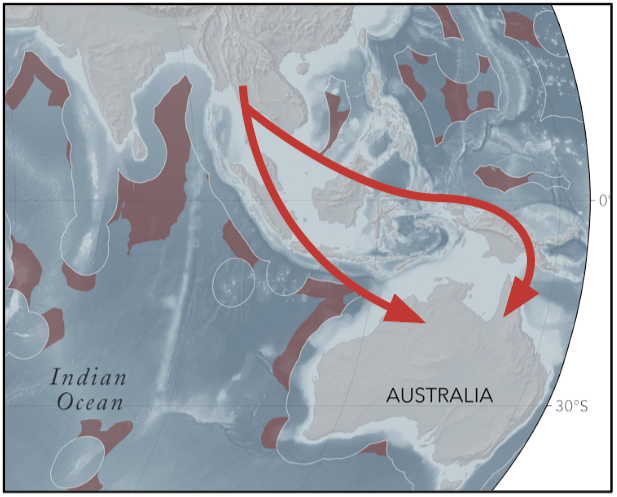
That fact has led evolutionary scientists to postulate that that is how humans reached Australia during the Ice Age.10 Gemma Tarlach, writing in Discover magazine, explained,
From the North Sea to the island-dotted tropics between Asia and Australia, from the frigid waters of the Bering Strait to the sunny Arabian Peninsula, now-submerged coastal landscapes were exposed and accessible to our ancestors at multiple times in prehistory, including key periods of human expansion across the globe. The square mileage of these areas now under the seas is equal to that of modern North America.11
Tarlach applies the same concept to the pathway between central Europe and England/Scotland during the Ice Age.
Look at a map of today’s Europe and its northern epicenters of population and commerce: London, Paris, Amsterdam, Copenhagen. Now consider that these hubs were once hinterland, mere fringes of an expanse rich in conifer forests, meadows, rivers and wetlands, all of it teeming with game. Prehistoric travelers could have walked from what’s now central Europe to northern Scotland without even seeing a coastline. As the massive glaciers and ice sheets of the…Ice Age began melting…, rising seas inundated this world. The North Sea was born.12
Bottom line: using the geography of today to draw conclusions about the past is unreliable at best, even according to many evolutionists. Humans and animals could have used land bridges to disperse after the Flood.
(5) Log “Islands”
It is also likely that for some time, remnants of the great forests of the pre-Flood period would have been floating on the receding waters of the Earth until their decay was completed. As is the case from localized floods today, small “land masses” composed of trees and debris are often found floating on the water (e.g., traveling down rivers). Much larger islands of plant material and debris are found associated with larger catastrophes as well. For example:
- Such a land mass of trees can still be seen on Spirit Lake, a result of the eruption of Mount Saint Helens volcano 45 years ago.
- After the 2011 Japan tsunami, an island of debris was spotted floating across the Pacific Ocean towards the U.S. west coast. The island was 69 miles in length and covered an expanse of over 2.2 million square feet.13
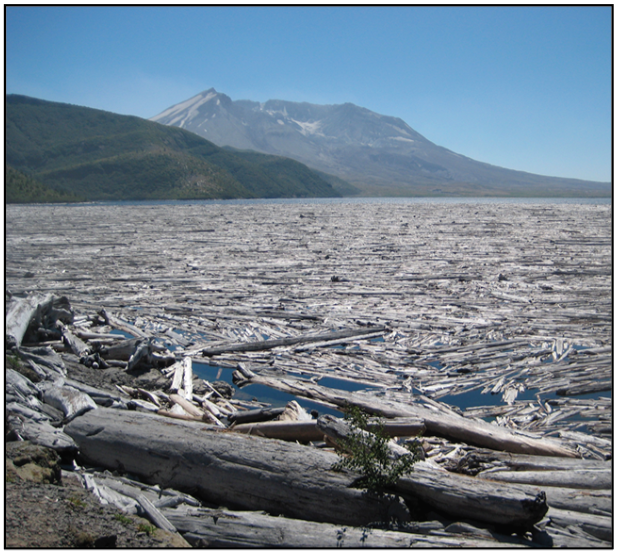
But is it likely that animals would be found floating on such debris islands? Some scoff at the idea, but they only do so out of ignorance. After all, three weeks after the 2011 Japan tsunami, the Japan Coast Guard found and rescued a dog that had been floating on one of the tsunami’s debris islands.14 Such a scenario may very well explain the existence of dingoes in Australia. Graham Lawton, writing in New Scientist, even noted that,
After the 2011 Tohoku earthquake and tsunami in Japan, around 300 Japanese marine species were found on the shoreline of British Columbia having been carried on artificial debris. Some larger vertebrates, such as tortoises, crocodilians and possibly even hippos, may be able to float or swim. Of course, sceptics can’t just pour cold water on the idea. The presence of particular animals in certain faraway places still requires an explanation, so what have they got?15
Paleontological and archaeological evidence indicates that humans made it to the continent of Australia after the Flood and before Abraham.16 Lawton explained that scientists have long thought that humans could have arrived there accidentally, assuming that
[p]eople must have arrived on the currents after being washed into the sea by a tsunami or flood, perhaps clinging to a mat of floating vegetation or a raft of pumice. This so-called “sweepstake colonization” is often invoked to explain how terrestrial reptiles and mammals make it onto distant tropical islands, and it could plausibly account for the peopling of Sahul. Prevailing ocean currents are favourable and any floating castaways caught in them would have found the vast Sahul “hard to miss”, according to archaeologist Jane Balme at the University of western Australia in Perth.17
Bruce Hardy, the chair of the Department of Anthropology at Kenyan College in Ohio, agreed about the plausibility of the rafting hypothesis for human migration to isolated locations, arguing that migration could have occurred by “natural rafts drifting and leading to human occupation of some of these islands.”18 They could have “drifted to islands atop natural vegetation mats.”19 If humans could drift in such an accidental manner, why not animals?
Lawton agreed, arguing that monkeys and other animals also could have “sailed across oceans on floating islands of vegetation.”20 Colin Barras, writing in New Scientist, said, “We know…that small monkeys somehow made it across the [strong current, dangerous Wallace—JM] line to Sulawesi and clearly they didn’t use boats—in all likelihood they floated over on mats of vegetation”—possibly even dozens of the monkeys.21 In fact, Lawton noted that,
The rafting hypothesis is as old as the theory of evolution itself. In On the Origin of Species, Charles Darwin pointed out that the flora and fauna of the Galapagos Islands were clearly related to those of South America, while Cape Verde’s were distinctly African…. His point was to discredit the belief that each species was a unique, divine creation, but he inadvertently launched the idea that the inhabitants of distant islands must have somehow blown in from the mainland.22
Concerning how species (e.g., plants, seeds, and invertebrates) dispersed to oceanic islands, Darwin suggested that they could have been transported by seaweed, “floating timber,” “drifted by the prevailing currents,” or could have “floated in chinks of drifted timber.”23 The Galapagos Conservancy, discussing the “raft theory” of how species arrived on the islands, acknowledged that many must have arrived by
sea while swimming or floating, sometimes with the aid of rafts of tangled vegetation. It is likely that the ancestors of present-day Galapagos animals that are good swimmers (sea lions, sea turtles, penguins) actually swam their way to the islands with the help of some swift ocean currents. On the other hand, it is believed that many of the reptiles and small mammals (rice rats) were carried to the islands from the South or Central American mainland on rafts of vegetation. The vast majority of such rafts would have sunk well before they ever reached Galapagos, but it would have only taken a handful of successful rafts to wash ashore to explain the present reptile diversity in Galapagos.24
Caccone, et al. add that “tortoises probably reached the [Galapagos—JM] islands by rafting from South America, 1000 km to the east” using the Humboldt Current.25 A BBC Documentary on the South Pacific reasoned, “As tsunamis strike the coast, rafts of vegetation can be cast adrift. Perhaps animals were caught up in those rafts, too. Could this have been the answer to how these animals [Fijian crested iguanas—JM] made it to Fiji? After all, they are the heartiest of their kind and could have survived long sea journeys.”26
Bottom line: evolutionists cannot “have their cake and eat it, too”—either raft travel is ridiculous or it’s reasonable. In truth, if evolutionists are right, it is not at all outlandish to suppose that massive debris islands would have been found worldwide after the Flood and that animals could have been found floating on them in the years immediately after the Flood.
Migration by Swimming?
Consider: if one believes animal migration by rafting to be a ludicrous idea, what must he think when he hears the evolutionary theory that dinosaurs may have crossed to islands by swimming? Smithsonian Magazine highlighted research published in Cretaceous Research in 2021, in which scientists concluded that, since (according to the evolutionary timeline) Africa was surrounded by water when it was colonized by dinosaurs, “Swimming would have been the only way for the dinosaur to reach prehistoric Africa from Europe or Asia, reinforcing the idea that exceptional events can help species move between distant continents.”27 Referring to the same research, Phys.org noted that dinosaurs must have arrived in Africa by “water-rafting on debris, floating, or swimming,” and added the following telling statement:
Ocean crossings are rare, improbable events, but have been observed in historic times. In one case, green iguanas travelled between Caribbean islands during a hurricane borne on debris. In another, a tortoise from the Seychelles floated hundreds of kilometres across the Indian Ocean to wash up in Africa. “Over millions of years,” said [Nicholas—JM] Longrich [of the Milner Centre for Evolution at the University of Bath—JM], “Once-in-a-century events are likely to happen many times. Ocean crossings are needed to explain how lemurs and hippos got to Madagascar, or how monkeys and rodents crossed from Africa to South America.”28
While creationists would interpret the data to which evolutionists are referring differently, nevertheless, evolutionists have conceded yet another possibility for how animals could have migrated to various isolated locations.
In a more recent example that gives plausibility to the swimming option, in 2019, a small tsunami that struck the eastern coast of the U.S. during Hurricane Dorian, swept 20 cows and 28 horses from Cedar Island into the Atlantic Ocean off the coast of North Carolina. Three of the cows were later found alive over four miles away on a barrier island in the Outer Banks National Park. Apparently, the cows survived by swimming. One of the cows was pregnant while adrift and later gave birth to a healthy calf.29
Tertiary Ocean Currents—Evidence of the Rafting Hypothesis?
Could land animals have arrived on the Australian continent after the Flood via log mat? As added evidence of the legitimacy of that theory, recent genetic analysis suggests that Australian marsupials originated in South America before moving to Australia.30 When we look at the projections of what the ocean currents are thought to have been like during the Tertiary period (immediately after the Flood), we find that an ocean current was present, traveling directly from South America to Australia.31
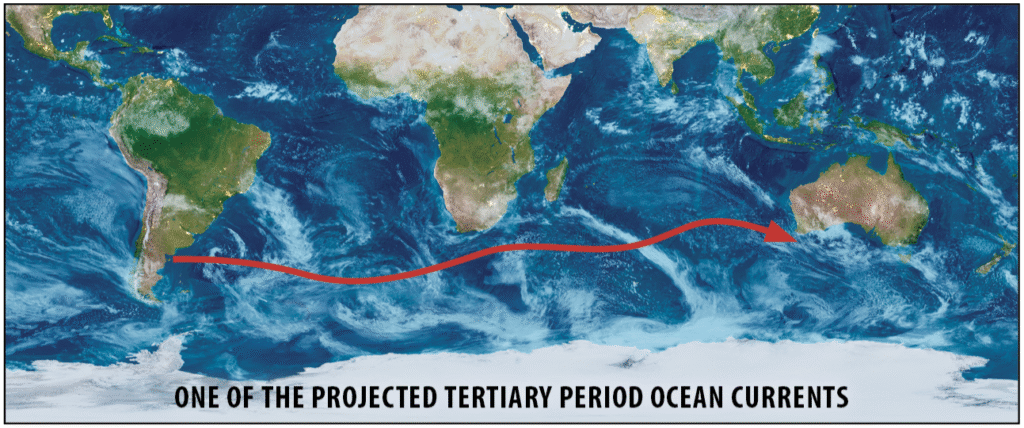
Bottom line: if tsunamis are virtually certain to create floating islands of debris, what would be expected from a global Flood with rapid tectonic activity creating enormous earthquakes and subsequent tsunamis?32 If animals and humans are known to be able to travel aboard such makeshift vessels, who’s to say that such mini-“continents,” with various animals along for the ride, would not have been commonly spotted immediately following the Flood? A radically different terrestrial environment, with species clamoring to find food on the newly disheveled Earth, could have caused accelerated dispersal of the Ark’s population from Ararat to Australia before Australia had moved too far from the mainland.
One would want to be cautious not to be too quick to invoke supernatural explanations for proposed scientific problems with Bible teaching, since it can lead to scientific laziness and effectively halt scientific investigation into the great works of the Lord (Psalm 111:2).33 However, when the biblical text suggests that divine assistance may have played a role in a biblical event, it would be poor hermeneutics to dismiss the possibility without consideration. In this case, Genesis 6:20 suggests that God gathered the animals for Noah before the Flood. It is plausible, therefore, to postulate that God would have been involved, at the very least Providentially, in the dispersal of the animals after the Flood. Clearly, He had several reasonable avenues with which to do so that would not have required miraculous assistance.34
(6) Humans Brought Them
Of course, one final possibility as to how animals dispersed to remote islands like Australia would be that humans carried them. After all, evolutionists themselves argue that is precisely how some animals were able to populate certain islands.35 As noted earlier, physical evidence appears to place humans in Australia after the Flood and before Abraham, during the Babel dispersion period.36 Who’s to say they did not arrive with animals in tow?
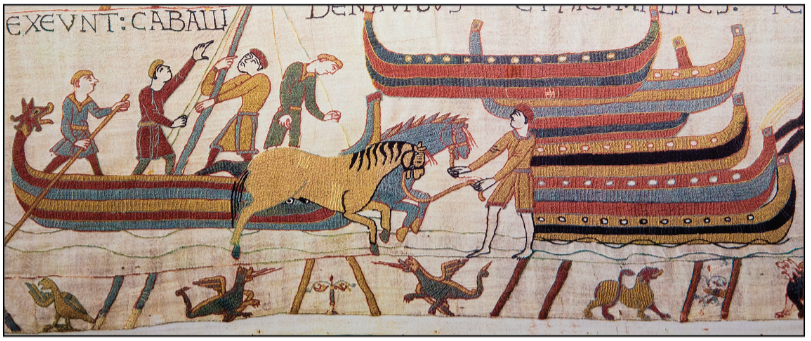
Lawton argued: “Another option, at least for more recent animal crossings, is that small creatures such as lizards were accidentally or deliberately transported by prehistoric humans. We know that our Stone Age ancestors were skilled seafarers, navigating across hundreds of kilometres of ocean to reach Japan…and perhaps even sailing from South-East Asia to Australia….”37 Granted, human transportation of animals is not available to evolutionists as an option in many instances, since they do not believe humans were on the scene yet (for example, when dinosaurs roamed the Earth). From a biblical perspective, however, humans have been on the scene “from the beginning of the creation” (Mark 10:6).
Conclusion
While post-Flood migration from the Ark to remote places like Australia has often been a charge used by evolutionists against the Bible and its account of a global Deluge, ironically, evolutionists themselves answer their own challenges with plausible options at the creationists’ disposal. Such attacks merely provide the biblical model another opportunity to prove itself to be reliable. “[S]coffers will come in the last days, walking according to their own lusts…. For this they willfully forget: that by the word of God the heavens were of old and the earth standing out of water and in the water, by which the world that then existed perished, being flooded with water…. Therefore, since all these things will be dissolved, what manner of persons ought you to be in holy conduct and godliness, looking for and hastening the coming of the day of God…?” (2 Peter 3:3b-12).
Endnotes
1 E.g., Bill Nye and Ken Ham (2014), Uncensored Science: Bill Nye Debates Ken Ham (Petersburg, KY: Answers in Genesis); Janet Kellogg Ray (2021), Baby Dinosaurs on the Ark? The Bible and Modern Science and the Trouble of Making It All Fit (Grand Rapids, MI: Eerdmans), pp. 101-103.
2 Andrew A. Snelling (2014), “Noah’s Lost World,” Answers in Genesis, https://answersingenesis.org/geology/plate-tectonics/noahs-lost-world/.
3 A. Snider-Pellegrini (1858), La Création et Ses Mystères Dévoilés (Paris: A. Franck et E. Dentu).
4 Today, creationists argue that Pangaea formed and broke apart during the Flood and, therefore, only ever existed underwater. Rodinia is thought to have been the supercontinent of the pre-Flood world. See Snelling.
5 E.g., Ross N. Mitchell, David A.D. Evans, and Taylor M. Kilian (2010), “Rapid Early Cambrian Rotation of Gondwana,” Geology, 38[8]:755-758; Brian Thomas (2010), “Continents Didn’t Drift, They Raced,” Institute for Creation Research, http://www.icr.org/article/continents-didnt-drift-they-raced/; Steven Austin, John Baumgardner, D. Russell Humphreys, Andrew Snelling, Larry Vardiman, and Kurt Wise (1994), “Catastrophic Plate Tectonics: A Global Flood Model of Earth History,” Proceedings of the Third International Conference on Creationism, ed. R.E. Walsh (Pittsburgh, PA: Creation Science Fellowship), pp. 609-621; S.P. Grand (1994), “Mantle Shear Structure Beneath the Americas and Surrounding Oceans,” Journal of Geophysical Research, 99:11591-11621; J.E. Vidale (1994), “A Snapshot of Whole Mantle Flow,” Nature, 370:16-17.
6 Michael Oard (2004), “The Genesis Flood Caused the Ice Age,” Answers in Genesis, http://www.answersingenesis.org/articles/fit/flood-caused-ice-age.
7 Charles Darwin (1859), On the Origin of Species by Means of Natural Selection, or the Preservation of Favoured Races in the Struggle for Life (London: John Murray), https://darwin-online.org.uk/content/frameset?itemID=F373&viewtype=text&pageseq=2, pp. 346-410.
8 “Argos Used to Track Fox’s 2,700-mile Journey from Norway to Canada” (2019), NOAA NESDIS, July 17, https://www.nesdis.noaa.gov/news/argos-used-track-foxs-2700-mile-journey-norway-canada.
9 United States Geological Survey (2022), “How Does Present Glacier Extent and Sea Level Compare to the Extent of Glaciers and Global Sea Level During the Last Glacial Maximum (LGM)?” January 27, https://www.usgs.gov/faqs/how-does-present-glacier-extent-and-sea-level-compare-extent-glaciers-and-global-sea-level; see also Gemma Tarlach (2019), “Return to Aquaterra,” Discover, 40[5]:56, June.
10 See Graham Lawton (2020), “Finding Sahul,” New Scientist, 245[3266]:39, January 25—Due to lower sea levels during the Ice Age, “the Sahul coast would have been significantly closer to the easternmost of the south-eastern Asian islands”; also, Christopher Bae, Katerina Douka, and Michael Petraglia (2017), “On the Origin of Modern Humans: Asian Perspectives,” Science, 358[6368]:1269, December 8; Kate Ravilious (2017), “The First Australians,” Archaeology, 70[4]:49, July/August. Uncovered land bridges are also how scientists are postulating that dinosaurs migrated from North America to Africa [Vicky Just (2020), “The First Duckbill Dinosaur Fossil from Africa Hints at How Dinosaurs Once Crossed Oceans,” Phys.org, November 5, https://phys.org/news/2020-11-duckbill-dinosaur-fossil-africa-hints.html].
11 Tarlach, p. 56; see also Colin Barras (2018), “Stone Age Sailors,” New Scientist, 238[3180]:36-37, June 2.
12 Ibid., p. 62.
13 Danielle Demetriou (2011), “Massive Floating Rubbish Islands from Japan Tsunami Spotted on Pacific,” The Telegraph, April 8, http://www. telegraph.co.uk/news/worldnews/asia/japan/8437632/Massive-floating-rubbish-islands-from-Japan-tsunami-spotted-on-Pacific.html.
14 “Japan Earthquake: One Month Later” (2011), The Atlantic: Photo, April 7, http://www.theatlantic.com/photo/2011/04/japan-earthquake-one-month-later/100041/.
15 Graham L. Lawton (2021), “On a Raft and a Prayer,” New Scientist, 252[3365/3366]:52, December 18/25.
16 Lawton (2020), p. 39. Conventional dating methods suggest that humans arrived in Australia 65,000 years ago, during the Ice Age [Danielle Demetrioue (2011), “Massive Floating Rubbish Islands from Japan Tsunami Spotted on Pacific,” The Telegraph, April 8, http://www. telegraph.co.uk/news/worldnews/asia/japan/8437632/Massive-floating-rubbish-islands-from-Japan-tsunami-spotted-on-Pacific.html]. Accounting for the continuing, though diminishing, accelerated nuclear decay in the post-Flood years [Jeff Miller (2013), “Don’t Assume Too Much: Not All Assumptions in Science Are Bad,” Reason & Revelation, 33[6]:62-70], 65,000 years correlates to a pre-Abraham date ca. 2,200-2,100 B.C.
17 Lawton (2020), p. 38, emp. added.
18 As quoted in Sam Walters, et al. (2024), “Everything Worth Knowing About Neanderthals,” Discover, 45[3]:33, May/June.
19 Ibid.
20 Lawton (2021), p. 50.
21 Barras, pp. 38-39.
22 Lawton (2021).
23 Darwin, pp. 360,391,397,399.
24 “History of Galapagos” (no date), Galapagos Conservancy, accessed February 11, 2025, https://www.galapagos.org/about_galapagos/history/, emp. added.
25 Adalgisa Caccone, et al. (1999), “Origin and Evolutionary Relationships of Giant Galapagos Tortoises,” Proceedings of the National Academy of Sciences, 96[23]:13223, November 9, emp. added.
26 “South Pacific: Castaways (Episode 2)” (2009), BBC Studios: Natural History Unit, aired May 17. The documentary also postulates that geckos may have reached the Solomon Islands by vegetation raft.
27 Riley Black (2020), “The Top Ten Dinosaur Discoveries of 2020,” Smithsonian Magazine on-line, December 22, https://www.smithsonianmag.com/science-nature/top-ten-dinosaur-discoveries-2020-180976578, emp. added.
28 Just; The saltwater crocodile is thought to have swam 60 miles from New Guinea to the Solomon Islands (“South Pacific…”).
29 Mark Price (2020), “Cow That Swam 5 Miles to Outer Banks in a Hurricane Was Pregnant. It Just Gave Birth,” The News & Observer, February 20, https://www.newsobserver.com/news/local/article239953898.html.
30 Clara Moskowitz (2010), “Marsupials Not From Down Under After All,” LiveScience.com, July 27, https://www.livescience.com/6770-marsupials.html.
31 Warren D. Allmon (2023), “Tertiary Period,” Encyclopaedia Britannica on-line, https://www.britannica.com/science/Tertiary-Period. Note that an ocean current is also thought to have been present that led from the theorized location of Ararat to South America.
32 For more information about the modern biblical Flood model accepted by most Creation geologists, see Jeff Miller (2019), “Was the Flood Global? Testimony from Scripture and Science,” Reason & Revelation, 39[4]:38-47, https://apologeticspress.org/wp-content/uploads/2021/08/1904w.pdf.
33 Jeff Miller (2024), “Is it Ever Appropriate to Say ‘God Did It’ in Response to a Scientific Challenge?” Reason & Revelation, 44[6]:11, June, https://apologeticspress.org/wp-content/uploads/2024/05/2406-web.pdf.
34 An example of a supernatural option would be the miraculous transportation of animals to remote continents/islands.
35 “Enigmatic Falklands ‘Fox’ Might Have Hitched a Ride with Humans” (2021), Nature, 599[7883]:10, November 4.
36 Lawton (2020).
37 Lawton (2021), p. 52, emp. added.

REPRODUCTION & DISCLAIMERS: We are happy to grant permission for this article to be reproduced in part or in its entirety, as long as our stipulations are observed.
posted by Believer | 1:00 AM

0 Comments:
Post a Comment
<< Home