

Clarence Darrow: The Lawyer Who Couldn’t Beat the Bible
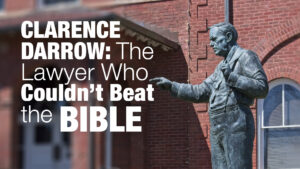
Clarence Darrow: The Lawyer Who Couldn’t Beat the Bible


July 2025 marked the 100th anniversary of the infamous Scopes “Monkey” Trial—a landmark courtroom drama that pitted early 20th-century science against the Bible in the quiet town of Dayton, Tennessee.1 At the heart of the controversy stood Clarence Darrow, one of the most prominent attorneys in the United States. He represented John Scopes, who had been charged with violating the Butler Act—a Tennessee law banning the teaching of human evolution in public schools. The trial, carefully orchestrated by both civic leaders and the ACLU, became a symbolic battleground over the cultural authority of science versus Scripture. Although Darrow eventually lost the case, his antagonism toward biblical faith carried on for years to come.
Only a few years before the Scopes trial, Darrow authored a short pamphlet titled Absurdities of the Bible. He sought to debunk Scripture through ridicule and rhetorical flair. Despite his impressive understanding of the legal system, Darrow’s approach to the Bible betrayed a conspicuous lack of familiarity with the book he aimed to discredit. His pamphlet featured a staggering amount of misinformation about the Bible, as well as theological illiteracy and a disregard for the Bible’s historical, cultural, and literary context.
What if we were to cross-examine Darrow’s treatment of the evidence? In Absurdities of the Bible, he makes the following blunders:
- Darrow used numerous logical fallacies in his pamphlet. One of his favorites is the strawman fallacy—he caricatures biblical content and treats texts as if all Christians read them with extreme literalness, ignoring genre and figures of speech. He employs ad hominem attacks, as in his description of Christians as decidedly anti-intellectual.2 Darrow makes a false analogy by highlighting miraculous birth stories outside of the biblical text, implying that the story of Jesus’ birth must be equally untrue.3 He often commits the fallacy of hasty generalization in condemning the text as morally bankrupt based on isolated and misinterpreted examples. Finally, he commits the fallacy of bifurcation—also known as the false dichotomy—in claiming that either a person uses reason and rejects the Bible or believes biblical stories at the expense of using any intelligence.4
- He claims that the Bible teaches a flat Earth,5 although it does not.6 Critics often mistakenly cite phenomenological language (describing how things appear to an observer, rather than how they objectively are; Ecclesiastes 1:5) or poetic phrases such as “the four corners of the earth” (Isaiah 11:12; Revelation 7:1; see also Ezekiel 7:2) as evidence (it should be telling that the overwhelming majority of texts that supposedly teach a flat Earth are poetic in nature).7
- Darrow’s mockery of the Balaam narrative in Numbers 22-24 mistakenly refers to the prophet as a Jew. He also refers to Asia as “a land of myth and fable and ignorance in the main.”8 Both statements could be read as ethnocentric in origin and as racially insensitive.
Darrow’s disparaging pamphlet is little more than an intellectually bankrupt screed. He often inserts details not found in the text and dishonestly exaggerates biblical details to accentuate their supposed absurdity. Darrow may have been a skilled lawyer, but when it came to understanding Christianity, he was far out of his depth. Between the Absurdities of the Bible and the Scopes “Monkey” Trial, Darrow had a winless record of 0-2 against Scripture.
For all his courtroom brilliance, the famed attorney gave little indication that he could participate in a serious engagement with the faith he so quickly dismissed.9 Darrow’s legacy is an object lesson in what happens when a sharp mind attempts to make a case without first understanding the evidence. He would have been much better served by approaching the Bible with a humble heart and diligence, sincerely desiring to know the truth.
Endnotes
1 For more information on the trial, see Eric Lyons (2025), “100 Years Later: Revisiting the Scopes ‘Monkey’ Trial,” Reason & Revelation, 45[7]:2-6,8-11, July, apologeticspress.org/100th-anniversary-of-the-scopes-monkey-trial/.
2 Clarence Darrow (1929), Absurdities of the Bible, Little Blue Book no. 1637 (Girard, KS: Haldeman-Julius), p. 5.
3 Ibid., pp. 7-8.
4 Ibid., pp. 9-10.
5 Ibid., p. 4.
6 See Justin Rogers (2017), “Does the Bible Teach a Flat Earth?” Reason & Revelation, 37[7]:74-77, July, apologeticspress.org/does-the-bible-teach-a-flat-earth-5428/.
7 The phrase “four corners of the earth” is an ancient phrase indicating “all the Earth.” It is derived from a royal title used by ancient kings in Mesopotamia. The first to refer to himself as the “King of the Four Corners of the Earth” (or “Four Quarters”) seems to have been Naram-Sin of Akkad (c. 2254-2218 B.C.). This title simply meant that Naram-Sin considered himself a universal sovereign over the entirety of the Earth. This phrase, like its biblical usage, did not communicate the concept of a flat Earth.
8 Darrow, Absurdities, pp. 6 and 9, respectively.
9 Here we might point out that Darrow debated the English writer and apologist G.K. Chesterton and appeared to have lost that debate in the eyes of many in the audience. The two met on January 18, 1931 in New York City to debate whether Christianity had been a force for good or ill in the world. Darrow took a hostile, sarcastic tone in attacking the Christian faith for its supposed historical abuses and stifling effect on intellectual progress. His attempts to bait Chesterton into getting angry failed, with Chesterton responding consistently with grace under fire. Although the debate did not produce a clear winner, much of the audience favored Chesterton, including those who did not share his spiritual perspective.

REPRODUCTION & DISCLAIMERS: We are happy to grant permission for this article to be reproduced in part or in its entirety, as long as our stipulations are observed.
posted by Believer | 1:30 AM

0 Comments:
Post a Comment
<< Home