


Burn Layers: Traces of Judgment, Echoes of Grace
Burn Layers: Traces of Judgment, Echoes of Grace

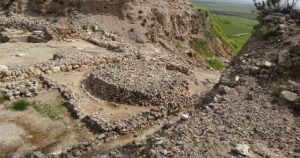
Just weeks ago, my wife Kim and I returned from Israel, where we spent over a week working on archaeological excavations at ancient Shiloh. Along the way, we also revisited one of my favorite—yet often overlooked—sites: Jericho. Each time I bring a group to this city, I’m struck by how empty it feels. Few tourists stop there, and it’s easy to see why. Without knowledge of the site’s history and stratigraphy, Jericho appears desolate—like the cratered surface of the moon, its features blurred by erosion, time, and the rare but punishing winter rains. But this time was different. I took our group to a lesser-known section where a clearly visible burn layer cuts through the ancient soil—a dark scar of fire and collapse. I’ve seen many like it over the years, but this one affected Kim deeply. Then, just days later, alarms sounded across Israel. Missiles were being launched. The skies above the very places we had walked were now filled with threats of destruction. We managed to leave just before the Tel Aviv airport was closed, but unfortunately some of our dig team were not able to leave in time before things escalated with Iran. That experience—and Kim’s quiet reflection afterward—led to this essay. She saw, in those layers of ash, not only a history of judgment but a deeper sorrow: that so many in the land of promise still do not know the One who can save them. She urged me to write about burn layers. So I did.
Burn Layers: What the Ashes Reveal
The ruins of ancient cities often whisper a grim and powerful story. Among the most compelling voices in archaeology are what scholars call “burn layers”—literal strata of ash, charred debris, and collapsed walls embedded in the Earth. These layers are not just discolorations in sediment. They are fixed points in time—clear markers of when destruction fell upon a people or place. Whether caused by conquest, divine judgment, or civil unrest, a burn layer says with quiet certainty: something ended here.
Time is a cruel editor. These once-vivid scars fade, weathered by erosion, obscured by rebuilding, or dismissed by those who no longer remember. Even when archaeology uncovers them, interpretation is not neutral.
One of the most debated burn layers in biblical archaeology is at Jericho. Scholars like Bryant Wood and earlier John Garstang found remarkable correspondence between the site’s destruction and the biblical account in Joshua 6. Their excavations uncovered large storage jars filled with charred grain—evidence of a sudden conquest during spring harvest, not a prolonged siege. Mudbrick walls had collapsed outward, consistent with the biblical account that the walls fell “flat” and the people went “up” into Jericho. Houses built against the city wall, like Rahab’s, were also found. The city had been consumed by fire—exactly as the text says.
Yet Kathleen Kenyon, and more recently Lorenzo Nigro, rejected this alignment. Kenyon dismissed Garstang’s findings, arguing there were no city walls standing at the time of Joshua, based in part on her claim that imported Cypriot pottery was absent. But that pottery was found by Garstang and confirmed by others. Nigro, following Kenyon’s flawed framework, ignored the broader material record, including the stratigraphy and scarabs. Notably, a series of Egyptian scarabs, ending with one from the reign of Amenhotep III (ca. 1390-1352 B.C.), clearly suggests occupation during the Late Bronze Age—around the time of the conquest if one follows a biblical timeline.
This tells us something deeper about archaeology: facts can be reinterpreted, or even ignored, when they challenge dominant assumptions. In today’s climate, any evidence aligning with Scripture is suspect by default. But burn layers don’t care about academic fashion—they remain silent witnesses of destruction and judgment. Those who dismiss what lies beneath do so while treading unknowingly atop fragile ground, suspended above the ashes of forgotten judgment. Like the civilizations they study, they too may one day become a burn layer—testimony to the cost of ignoring truth.
Burn layers tie us to a specific point in the past when civilization collapsed. Shiloh, for example, has a burn layer dating to around the rise of the Philistines in the 11th century B.C., likely corresponding with the events of 1 Samuel 4. But Shiloh was later rebuilt. New generations lived on top of the destruction, unaware or unconcerned with what had come before. The layers beneath their feet were forgotten—and so were the warnings they held.
Would we live differently if we could see the burn layers beneath our feet? Would it change our trajectory if we remembered what lies just below the surface—the remains of cities destroyed by pride, violence, and the rejection of God? The Bible says, “They have not known nor understood: for he hath shut their eyes, that they cannot see; and their hearts, that they cannot understand” (Isaiah 44:18, KJV). Generations walked above the ruins of their ancestors with no recollection of the judgment that once came. And so they repeated it.
Hazor, Lachish, Ai, and Gezer all show burn layers. In many cases, these align with moments of divine intervention or judgment as recorded in Scripture. At Hazor, a massive destruction layer has been found in the palace—dated by many to the time of Joshua. At Lachish, arrowheads and ash speak to the firestorm brought by Sennacherib in 701 B.C. But not every site has a burn layer that survives. Natural forces erase them. Cities are paved over. And in some cases, God may choose to let the memory fade. Even so, their stories remain in Scripture.
What will our own civilization leave behind? Rome left marble. Babylon left bricks. Greece left amphitheaters. But all of them left burn layers, too. Every empire burns—whether by foreign armies, internal collapse, or divine decree. Burn layers are what remain when the illusion of permanence is shattered. They are the buried sermons of history.
As wars rage and bombs fall in the modern world, we ask: what burn layers are being created now? What will archaeologists one day find beneath our cities? More importantly, what will they say about who we were—and what we worshiped?
Burn layers matter. They are more than scientific evidence. They are reminders. Archaeology can reveal them. Only Scripture can interpret them. “[T]he Most High rules in the kingdom of men” (Daniel 4:17). Jericho’s ash still speaks. So does Jerusalem’s. And maybe one day, ours will too.
Burn Layers Beneath Our Feet
In every age, there are those who refuse to see the warning signs—those who walk confidently over glass floors stretched thin across the flames of the past. But burn layers do not lie. They record the fall of kingdoms, the arrogance of empires, and the finality of divine justice.
Yet sometimes, even within the soot and ash of destruction, the grace of God still glimmers. At Jericho, where the walls fell in terrifying collapse and the city burned in judgment, one household stood untouched. Amid embers and ruin, a scarlet cord hung from a window. Rahab, a woman once far from righteousness, was saved—she and her family—because she believed, and obeyed. Her deliverance was not an accident of war, but an act of grace. She trusted the word of the Lord, and in the middle of judgment, she found mercy.
Sometimes, within the burned layers of ash and soot, the grace of God can be found. This is the paradox of divine justice—that while nations fall and cities are consumed, God still sees the faithful. And He still saves.
Jeremiah was branded a traitor for urging surrender to Babylon. But he saw the destruction coming. He could already smell the smoke. When his cries went unheeded, Jerusalem was reduced to rubble and ash—a burn layer beneath a once-golden city.
One day, all human kingdoms will fall. Their legacies will lie buried beneath the dust of time. But in that day, may we be found not among the ruins—but among the redeemed. For there is a kingdom that will never fall, a city that will never burn. And there is One whose grace can save us—even from the fire.
What will our generation leave behind? Perhaps not a layer of ash, but a headstone. A fossilized echo of misplaced trust and spiritual neglect. Yet for those who listen, burn layers are not just about endings. They are a call to choose what will never burn. The kingdoms of this world fall. But “we are receiving a kingdom which cannot be shaken” (Hebrews 12:28). There is only one foundation that will never become a layer of ruin: the one built on the eternal King.
Let the ashes remind us—not only of what was lost—but of what remains unshakable.


REPRODUCTION & DISCLAIMERS: We are happy to grant permission for this article to be reproduced in part or in its entirety, as long as our stipulations are observed.
posted by Believer | 1:00 AM

0 Comments:
Post a Comment
<< Home