


What Do We Mean by “Yahweh”?

What Do We Mean by “Yahweh”?


One of the most frequent nouns in the Hebrew Bible is God’s personal name, “Yahweh.” Found approximately 6,800 times in the Hebrew Bible—more than any other proper noun—it serves as the central identifier of the covenant God of Israel. Yet, despite its frequency, it remains one of the most misunderstood and debated terms in biblical studies. Rendered variously as “the Lord” (note the small caps), “Jehovah,” or simply “the Name,” this term offers a profound window into the ancient Hebrew understanding of God’s nature and presence. In this article, we will explore how the original ancient Hebrew scribes showed reverence for the name of God and survey modern speculations on what the name “Yahweh” means.
Distortions of the Name
As important as the name of God is, there are distortions of it in the popular imagination. One example is the “Yahweh meme” that continues to circulate on social media (see Figure 1). This meme is sometimes captioned with the notion that the word “Yahweh” is onomatopoetic and represents the act of breathing. Hence, the inhale (“yah”) and the exhale (“weh”) proclaim God’s name with every breath. Such an assertion sounds powerful and can even be correlated with Scripture, for God indeed gives breath to all living things (e.g., Genesis 2:7; Isaiah 42:5). Unfortunately, the claim is fallacious. No ancient interpreter ever claimed it, and the theory has no linguistic credibility. Apparently, an overeager rabbi is responsible for the notion. “Yahweh” is not an onomatopoetic representation of breathing.

An older and better-known distortion of the name “Yahweh” is the made-up word “Jehovah.”1 Though reverent in intent, the word was created in an effort to combine the Masoretic Ketiv (“what is written”) and the Qere (“what is read”). To explain, out of reverence for the divine name, Jewish readers avoided pronouncing “Yahweh” aloud, substituting instead the term ‘adonai (“my Lord”). This substitution became traditional and is still practiced in Jewish reading custom today. In the Middle Ages, Christian transliterators thought it would be a good idea to take the consonants of Yahweh—in Latin “JHVH”—and add the vowels of ‘adonai, thereby creating (with slight modifications) the word “Jehovah.”The earliest known use of “Jehovah” dates to 1381, and the term gained currency in the English-speaking world through translations such as the King James Version (1611) and the American Standard Version (1901). By contrast, the English Standard Version (2001) and the New American Standard Bible (2020) never use the word “Jehovah.”
Reverence for the Name
In Scripture
The sanctity of the divine name is a major biblical theme. The third commandment in Exodus 20:7 declares, “You shall not take the name of the LORD your God in vain, for the LORD will not hold him guiltless who takes his name in vain” (ESV). The prohibition is not merely about speech but about bearing (nāśā’) the name of Yahweh in a way that misrepresents or fails to respect His character. God’s name is bound to His reputation and covenantal presence among His people.
The gravity of misappropriating the name is further illustrated by the man who curses the name (Leviticus 24:10-16). Those who heard the curse were required to testify and participate in the execution, thereby bearing witness and upholding the holiness of God’s name. This explains that words absolutely matter, and that cursing the divine name was tantamount to assaulting God. On the positive side, Deuteronomy 12:3-5 commands Israel to seek “the place that the Lord your God will choose…to put his name.” This shows that God’s “name” signifies more than a moniker by which He is known. On the contrary, the name represents His very presence and authority. Therefore, when the people of Israel honor God and His sanctuary, they honor His name. The biblical reverence for the name of God reflects an attitude transmitted through the generations.
In the Dead Sea Scrolls
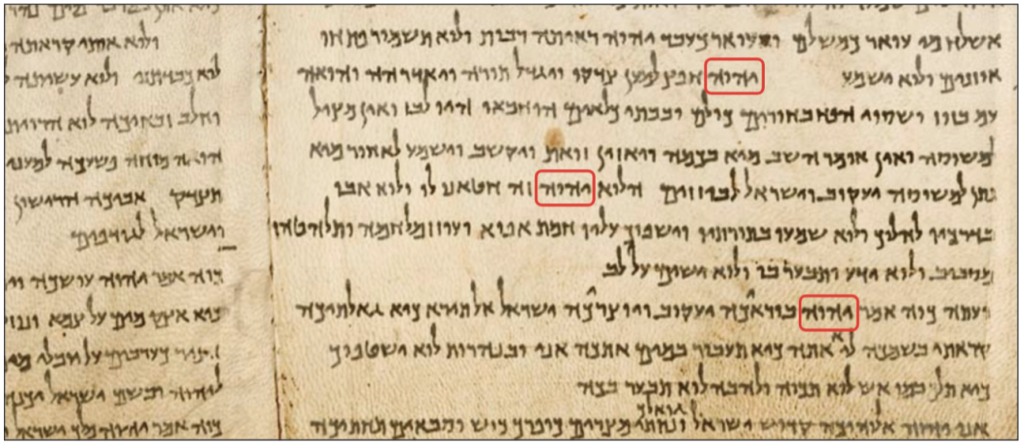
Reverence for the divine name continued and intensified in later Jewish tradition, as the Dead Sea Scrolls attest. The ancient biblical manuscripts from Qumran preserve fascinating differences in the ways they represent the name “Yahweh.” Some scribes simply write the name of God in square, Aramaic characters no different from the rest of the words in the manuscript. For example, the Great Isaiah Scroll (1QIsa) represents the divine name in the standard script (see Figure 2).
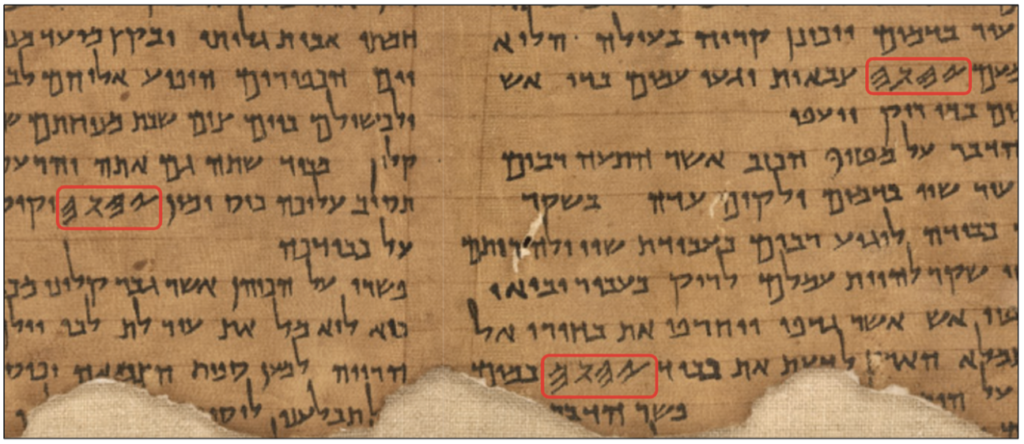
Other Hebrew manuscripts intentionally designate the name of God by using a different script. There is some evidence that the original scribe would leave a blank space where the name of God ought to appear. Perhaps a more senior scribe would then come along and write the name in Paleo-Hebrew letters. This practice was apparently intended to draw special attention to the name of God, indicating its sacredness in comparison with the other words in the text (see Figure 3).
A third way of representing the name of God in the Dead Sea Scrolls is the method simply called “tetrapuncta” (“four dots”). To avoid writing Hebrew letters altogether, some scribes replace the divine name with four large, distinct dots (see Figure 4). This writing method generally belongs to the non-biblical scrolls, but there are exceptions (some scrolls of Isaiah and Samuel use the tetrapuncta method).

Finally, some scribes wrote the term ‘adonai in place of the divine name YHWH in the text but add a marginal note or visual marker to note the change. This is the earliest example of the Ketiv-Qere method utilized by the later Masoretic scribes. With this method scribes transmitted accurately the text as “written” (ketiv) while signaling that a different term is to be “read” (qere). Perhaps this writing method suggests the custom of refusing to pronounce the name of God, encouraging the substitution of the word “Lord” instead (see Figure 5).

These variations seem to indicate a desire to preserve the sanctity of the divine name while also protecting the community from accidentally violating the commandment against misusing it. However, the scribes responsible for the Dead Sea Scrolls are not consistent in applying their methodology. For example, the Great Isaiah Scroll exemplifies multiple different methods of representing the name of God. Ultimately, we can observe the desire to highlight the name of God in a special way, but we cannot know exactly why the scribes did what they did.
The Greek Transliteration IAO (IAΩ)
With such reverence for the divine name, the earliest translators of the Bible faced a tremendous challenge: how does one render the name of God? The simplest method—still practiced by translators today—is to transliterate whatever words one cannot or does not wish to translate. At least one early translator of the book of Leviticus thus renders the divine name in Greek as ιαω (representing “yaw”) (see Figure 6).

Curiously, the divine name ιαω also appears frequently in the Greek magical papyri. These texts, composed by non-Hebrew speakers, suggest that the pronunciation of Yahweh’s name was known both inside and outside the Jewish community. The inclusion of the divine ΙΑΩ in incantations implies that the name was believed to carry special magical power even among pagan practitioners. While such usage is obviously indicative of a superstition contrary to biblical worship, it provides historical evidence that the name “Yahweh” was pronounced, at least among some Greek speakers. Thus, even in misappropriation, these sources testify to the enduring recognition of Yahweh’s name in its original form as a force to be deployed to one’s benefit.
The Meaning of the Name
So far, we have discussed respect for the name of YHWH, but it might be of interest to explore what the name means. Over time, interpreters proposed a range of possible meanings for YHWH, some drawn from related Hebrew roots.2
- “To be”: the most popular hypothesis derives the name from the verb hāyāh, meaning “to be.” Some scholars have suggested that the name of God is a causative form of the verb “to be,” indicating “he who brings into being.”3 If this is correct, then the emphasis is on God’s power to create. Support for this option derives from a wordplay in Exodus 3:13-15. At the burning bush, a hesitant Moses asks for God to reveal His name, which provokes the response, “I am who I am,” or “I will be whom I will be.” Lest this seem like a dismissal of the question, God instructs Moses to tell the Israelites, “I am has sent me to you.” The divine name consists of the consonants yod-hey-waw-hey (יהוה), and the term “he is” yod-hey-yod-hey (יהיה), nearly identical. “I am” is simply the first-person form of the term, personalizing what God is (or will be) to Israel. He will be for them, always sustaining and supporting them by His abiding presence.4 The Septuagint supports this derivation, translating the phrase, “I am the one who is” (ἐγὼ εἰμὶ ὁ ὤν), emphasizing “being” rather than “becoming.” This philosophical rendering shaped later Christian theology, linking Yahweh’s identity with divine immutability and eternity. The derivation from “to be” (hāyāh) remains the most likely explanation.5
- “To blow”: the same verbal root as YHWH possibly relates to the breath or spirit of God, but it rarely carries this meaning in Biblical Hebrew.
- “To fall” or “to rain”: storm deities were always popular (cf. Baal), and some suggest YHWH is connected with rain which falls from heaven. It is unlikely that the biblical God would be described in such unidimensional terms.
- “To destroy”: the same root refers to destruction, which could be connected to God’s power in judgment. However, this name would also signify a unidimensional God.
- “To desire, to be passionate”: the same root could imply God’s zealous love for His people, but this root is rare in Biblical Hebrew.
- Battle cry (“Yah!”): this term could possibly have been echoed in Israel’s war shouts through which invoking God’s name expressed dependence on His deliverance. The Bible leaves no example of this battle cry, thus rendering it highly unlikely as an explanation.
At the current state of evidence, we must admit that relating the name Yahweh to the verb “to be” is best, but other options exist, and it is impossible to be certain which is correct. The German theologian Walther Eichrodt aptly observes, “One can conclude…that in Israel people were less interested in the etymological interpretation of the name of God than in the concrete meaning it carried which was derived from elsewhere, namely, from historical manifestations of this particular deity’s power.”6
Conclusion
From the distortions of the divine name in modern times to the reverence shown in ancient times, from Moses’ burning bush encounter to the New Testament’s repeated identification of Jesus as Lord, the legacy of the name “Yahweh” stands as an enduring testament to the God who is and who acts. By drawing from the reception history of God’s name, we can be encouraged to avoid abstractions, oversimplifications, and irreverence. In so doing we learn to commune with the ancient people of faith who sought to preserve the sanctity of the name of God and be drawn deeper into our devotion to Him.
Endnotes
1 See Justin Rogers (2018), “Where Did ‘Jehovah’ Come From?” Reason & Revelation, 38[12]:134-136, December, apologeticspress.org/where-did-jehovah-come-from-5631/.
2 For a fuller discussion of the various possibilities, see the fine summary in Karel van der Toorn (1999), “Yahweh.” Dictionary of Deities and Demons in the Bible, ed. Karel van der Toorn, Bob Becking, and Pieter W. van der Horst (Leiden: Brill), pp. 910-919.
3 E.g., David W. Baker (2003), “God, Names of” in The IVP Dictionary of the Old Testament Pentateuch, ed. T. Desmond Alexander and David W. Baker (Downers Grove, IL: IVP), pp. 362.
4 Thomas B. Dozeman (2009), Exodus. Eerdmans Critical Commentary (Grand Rapids, MI: Eerdmans), p. 134.
5 David Noel Freedman (1986), “יהוה, YHWH,” Theological Dictionary of the Old Testament, ed. G. Johannes Botterweck and Helmer Ringgren, trans. David E. Green (Grand Rapids, MI: Eerdmans), 5:513.
6 Walther Eichrodt (1933), Theologie des alten Testaments (Leipzig: Hinrichs), 1:91.

REPRODUCTION & DISCLAIMERS: We are happy to grant permission for this article to be reproduced in part or in its entirety, as long as our stipulations are observed.
posted by Believer | 1:00 AM

0 Comments:
Post a Comment
<< Home