

A Monumental Discovery at Tel Shimron: How a Canaanite Cult Center Illuminates the Biblical World of Joshua
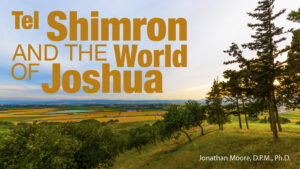
A Monumental Discovery at Tel Shimron: How a Canaanite Cult Center Illuminates the Biblical World of Joshua

The ancient Canaanite city of Shimron—named only briefly in the book of Joshua—has suddenly emerged as one of the most archaeologically significant sites in northern Israel. Recent discoveries atop Tel Shimron in the Jezreel Valley reveal a monumental Middle Bronze Age structure and a vast ritual favissa1 that together bring extraordinary clarity to the biblical world in which Shimron appears. What Scripture mentions in only a few lines now stands illuminated by one of the largest cultic deposits ever uncovered in the Levant.2
Shimron is introduced in Joshua 11, where Jabin of Hazor forms a northern coalition to resist Israel’s advance into Canaan. The text records: “When Jabin king of Hazor heard this, he sent word to Jobab king of Madon, to the kings of Shimron and Akshaph” (Joshua 11:1). Later, in Israel’s territorial allotments, Joshua 19 lists Shimron as one of the cities given to the tribe of Zebulun. These verses imply that Shimron was a fortified and influential regional center, powerful enough to join Hazor in resisting Israel and significant enough to receive a tribal inheritance. Egyptian records confirm its historicity: Thutmose III’s annals list Shimron as one of the Canaanite city-states that rebelled against Egypt during the fifteenth century B.C.
This background sets the stage for what archaeologists have now uncovered. Excavations led by Prof. Daniel Master of Wheaton College and Dr. Mario Martin of Tel Aviv University have revealed a monumental complex dating to around 1800 B.C. The discovery—first reported by journalist Ariel David in Haaretz on November 6, 2024—centers on a massive conical structure, a preserved mudbrick archway, and a large ritual favissa containing tens of thousands of cultic remains.3
At the summit of Tel Shimron, excavators uncovered a conical monument approximately 16-20 feet tall, intentionally coated in white chalk to make it visually striking. The rest of the city’s ramparts were covered in dark basalt chips, producing a dramatic contrast visible from great distances. “We are dealing with something…designed to be seen from very far away,” Master explained.4 Its height, placement, and coloration suggest it served as a public symbol of authority—whether royal, ceremonial, or territorial.
Nearby, archaeologists uncovered a rare, perfectly preserved mudbrick archway—one of the few examples of such architecture surviving intact in Canaan. This arch appears to have marked the entrance to an interior ceremonial space within the monument.
The most extraordinary discovery, however, was a chamber later converted into a massive favissa—a sacred repository for retiring ritual objects that could no longer remain in use. A favissa, as defined in Near Eastern ritual studies, is a designated area for depositing cultic items whose ritual function has concluded and which cannot be discarded casually. R.K. Harrison explains that such deposits served to “permanently remove from circulation objects whose sanctity or impurity prohibited further use,” preserving the integrity of sacred space.5
The Tel Shimron favissa is one of the largest ever excavated, measuring roughly 730 square feet and originally constructed with thick mudbrick walls and two staircases. Shortly after the structure was built, both stairways were intentionally sealed, and the chamber became a roofless deposition pit for sacred items. Archaeologists recovered approximately 40,000 burned animal bones, primarily from sheep, goats, and cattle—many burned at temperatures far exceeding domestic cooking. This strongly indicates ceremonial sacrifice.
Alongside the bones were 57,000 pottery sherds, including numerous miniature ritual vessels rather than domestic ware. The most striking objects were two bronze bull or calf figurines, likely representing Baal or El, the chief deities of the Canaanite pantheon. Added to this was an elaborately decorated Minoan jug imported from Crete—only the third such artifact found in Israel—demonstrating Shimron’s international trade connections and elite status.
The favissa contained no stratified layers, suggesting that its contents were deposited rapidly, either during a single major ritual event or in a short series of ceremonies. Many vessels were deliberately broken before deposition, a common ritual practice in the ancient Near East. The entire assemblage reflects a sophisticated and deeply polytheistic cultic system, one concerned with both the potency and the impurity of sacred objects.
This discovery sheds new light on the biblical narrative. The monumental scale, ritual complexity, and international connections of Middle Bronze Shimron align with the expectations for a city prominent enough to join Hazor in the coalition against Israel. The biblical portrait of a regional Canaanite power is not embellishment but a reflection of historical reality. When Scripture names the “king of Shimron,” it refers to a city whose ritual and political presence is now unmistakably confirmed by archaeology.
The Tel Shimron favissa also offers a compelling point of comparison with later Israelite practice. Israel, too, developed mechanisms for retiring sacred objects, but the nature of those deposits differs dramatically. Israel’s system, governed by Levitical law, emphasized purity, order, and the exclusive worship of YAHWEH. By contrast, the Tel Shimron favissa embodies the iconographic, multi-deity world of Canaan: bull images, high-intensity sacrificial burning, and ritual vessels tied to polytheistic worship. The conceptual overlap—retiring sacred objects—only accentuates the theological gulf between Israel and its neighbors.
One final detail is striking: though Tel Shimron was occupied in the Hellenistic, Roman, Islamic, and Ottoman periods, no later construction ever occurred atop the summit where the white monument once stood. Whether this was due to reverence, fear, or inherited cultural memory is unknown, but the result is remarkable. The Bronze Age complex lay undisturbed for nearly four millennia, its mudbrick walls and ritual archive preserved until modern archaeologists uncovered them.
The discoveries at Tel Shimron transform a brief biblical reference into a vivid historical setting. They reveal a Canaanite city of enormous ritual energy, political sophistication, and regional influence. In doing so, they remind modern readers that the world of Joshua was neither mythic nor imagined but firmly rooted in the complex and vibrant landscape of the Late Bronze Age.
[Dr. Jonathan Moore—Field Archaeologist with the Shiloh Excavation, Israel; Adjunct Faculty at Freed-Hardeman University; and Founder of Seeing His World, a missions-based educational nonprofit dedicated to providing academically grounded yet spiritually transformative guided experiences throughout the Bible lands (www.seeinghisworld.com).]
Endnotes
1 As discussed later in this article, a favissa is a special pit or room where ancient people placed religious objects that were no longer used but still considered sacred.
2 The eastern Mediterranean region.
3 Ariel David (2024), “Atop Tel Shimron, archaeologists reveal enigmatic monumental ‘white’ structure from Canaanite era…,” Haaretz, November 6, www.haaretz.com/archaeology/2024-11-06/ty-article-magazine/giant-trove-of-canaanite-cultic-artifacts-found-in-northern-israel/00000192-fc9e-d9d0-a996-fdfe51e50000.
4 Quoted in Ariel David (2024).
5 R. K. Harrison (1993), “Ebla Tablets and the Favissa Tradition,” Journal of the Evangelical Theological Society, 36[1]:3-8.

REPRODUCTION & DISCLAIMERS: We are happy to grant permission for this article to be reproduced in part or in its entirety, as long as our stipulations are observed.
posted by Believer | 1:30 AM

0 Comments:
Post a Comment
<< Home