


Christians at the Crossroads: The Megiddo Inscription and a Third-Century Prayer Hall
Christians at the Crossroads: The Megiddo Inscription and a Third-Century Prayer Hall


Located in northern Israel, Legio lies adjacent to ancient Tel Megiddo, a strategic site that dominated the Jezreel Valley and served as a key crossroads for military and commercial traffic along the Via Maris2—one of the most important ancient highways connecting Egypt to Mesopotamia. During the Roman period, the site became the headquarters of the Sixth Legion Ferrata (Figure 1) and played a crucial role in the imperial defense and communication network. Today, the location falls within the grounds of the modern Megiddo Prison (Figure 2), situated southeast of Kibbutz Megiddo.


[wikipedia.org (Oren Rozen) 2015 license cc-by-sa-3.0]
Figure 2: Modern Megiddo Prison [wikipedia.org (James Emery) 2007 license cc-by-sa-3.0
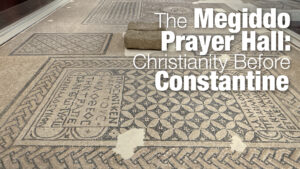
In 2005, during development work at the prison, an astonishing discovery was made when an inmate unearthed part of a 16 x 32-foot mosaic floor, soon identified as the centerpiece of a Christian prayer hall dating to the early third century A.D. The mosaic was one of 12 rooms within a large residential structure measuring approximately 6,500 square feet. Archaeological analysis revealed that this complex was not a typical private dwelling, as Yotam Tepper and Leah Di Segni explain, but “was utilized for both everyday use and military administrative purposes” and “served multiple functions: residential, military, as well as cultic, and combine private use with public ownership.”3 The architectural context—uniquely embedded within Roman military infrastructure—revealed a rectangular hall with mosaics, Greek inscriptions, and distinctive internal features characteristic of a domus ecclesiae, or house church, marking it as one of the earliest known Christian communal worship spaces ever discovered. In fact, pottery and coins recovered from the approximately 500-square-foot hall suggest construction around A.D. 230, with usage continuing until the end of the third century, which would make the Legio site the earliest known Christian worship facility discovered to date, predating the well-known domus ecclesiae at Dura-Europos by at least a decade.4
The dating of the Christian prayer hall at Legio to the early third century A.D. is of critical historical and theological significance. Prior to the Edict of Milan in A.D. 313, Christianity remained an unrecognized and often persecuted religion within the Roman Empire. Yet, the archaeological evidence from Kefar ‘Othnay offers compelling testimony to the existence of a formally organized Christian worship space decades before imperial legalization of Christianity.
ARCHITECTURE
While the structure lacks the monumental basilican form that would characterize later Constantinian church architecture, its internal features—such as a central podium, richly symbolic mosaics, and Greek inscriptions—indicate intentional liturgical use and spatial designation for Christian ritual. The architectural format closely resembles that of the Syrian house churches, wherein private residences were adapted for congregational gatherings. However, the Legio complex appears to have been associated with public or military ownership rather than private domestic use, suggesting a more complex model of early Christian spatial organization.5
SOCIOCULTURAL ENVIRONMENT
This setting—within a building used for both administrative and religious functions—challenges the prevailing narrative that early Christian worship was exclusively hidden, domestic, or marginal prior to Constantine. Furthermore, the community in which this prayer hall was built reflects the diversity of life in the Roman provinces. As Tepper and Di Segni note, Legio was home to “soldiers and civilians, Jews and Samaritans, Christians and pagans,” each with shared and distinctive religious and cultural practices.6 This mirrors the religious plurality visible at Dura-Europos, where Christian, Jewish, and pagan sanctuaries—including a synagogue, Mithraeum, and the so-called Christ house—occupied the same urban quarter.7 Thus, the congregation at Legio stands as a powerful witness to the culturally diverse setting in which early Christianity took root—publicly visible, socially integrated, and embedded within the heart of Roman military and civic infrastructure.
EPIGRAPHS
The epigraphic evidence embedded within the Megiddo Mosaic offers some of the most illuminating insights into the character and social dynamics of third-century Christian communities in Roman Palestine. Three Greek inscriptions, meticulously laid in black limestone against a white background in the mosaic floor, identify both the donors who sponsored elements of the prayer hall and their respective offerings, revealing a structured and participatory congregational setting.
Gaianus Inscription
The most prominent of the epigraphs is the northern inscription, commonly referred to as the Gaianus Inscription. Measuring over 11 square feet, it reads: “Gaianus, also called Porphyrius, centurion, our brother, has made the pavement at his own expense as an act of liberality. Brutius has carried out the work.”8 This text not only names the donor—Gaianus, a Roman centurion—but also emphasizes his Christian identity through the designation “our brother,” a term of spiritual kinship frequently found in New Testament usage.9 Such kinship terminology functioned to reinforce a sense of belonging and mutual obligation within early Christian communities, irrespective of social or military status. The mention of Brutius as the artisan suggests that the mosaic was likely executed by a single craftsman, whose Roman name further connects the project to the broader cultural landscape of the Roman Empire. The use of Greek rather than Latin in the inscription, coupled with Gaianus’s choice to employ his signum or nickname, “Porphyrius,” rather than a formal Roman title, suggests that the dedication was offered in a private religious capacity rather than as an official act of imperial representation.10
Intriguingly, the term for “centurion” (ἑκατόνταρχος) in this context is abbreviated with the Greek letters Chi and Rho (XP)—a standard shorthand for the word in epigraphic tradition, yet one that would soon take on deeply Christological significance. After Constantine’s self-reported “vision” at the Battle of the Milvian Bridge in A.D. 312, the Chi-Rho would become a universal Christian symbol, representing the first two letters of the Greek word Christos.11 Although its use at Megiddo likely predates this development and does not carry the same imperial connotation, it nonetheless hints at the growing confluence between Christian identity and symbolic language even before Constantine.
The Gaianus inscription, along with associated archaeological data, provides compelling evidence that the Christian community at third-century Legio included a diverse demographic drawn from the Roman military and its surrounding environs. This community likely consisted of soldiers, high-ranking officers, administrative personnel, their families and dependents, as well as members of the local civilian population. The presence of such a group in a prayer hall housed within a Roman military complex suggests the integration of Christianity into a traditionally pagan and hierarchical institution. While domestic shrines (lararia) dedicated to Greco-Roman deities are a common feature of Roman military installations, the prayer hall at Megiddo constitutes the earliest known chapel exclusively dedicated to Christian worship within a military context. Its significance is further underscored by the eventual ecclesiastical development of the region. The attendance of Bishop Paulus of nearby Maximianopolis at the Council of Nicaea in A.D. 325 indicates that Christianity had taken firm root in Legio in the decades following the military camp’s abandonment.
The Gaianus inscription adds yet another name to the growing list of Roman centurions in ancient Palestine who embraced the Christian faith. The New Testament references the office of the centurion—hekatontarchos or kenturiōn—24 times, depicting these figures as military commanders typically responsible for 60 to 80 soldiers.12 Several of these figures play significant roles in the Gospel accounts and early church history. One centurion in Capernaum, approximately 30 miles northeast of Megiddo, is described as a benefactor of a local synagogue and is notable for possessing a faith so profound that it astonished Jesus Himself (Matthew 8:5-13; Luke 7:1-10). Another centurion stands beneath the cross and, moved by Jesus’ suffering, confesses, “Truly this man was God’s Son!” (Mark 15:39, NRSV; cf. Matthew 27:54; Luke 23:47). The most pivotal figure, however, is Cornelius of Caesarea, situated less than 18 miles west of Legio. Cornelius’s conversion—together with that of his household—has long been recognized as the “Gentile Pentecost,”13 marking a turning point in the Church’s understanding that the Gospel message extended to Gentiles as well as Jews (Acts 10:1-11:18). The presence of Gaianus at Legio thus situates him within this notable tradition of Roman military officials who not only converted to Christianity but also served as significant patrons and exemplars of the faith.
One particularly revealing observation from the archaeological report is that the Legio congregation was composed predominantly “of pagan rather than Jewish origin.”14 This finding highlights the cultural pluralism of the early Christian movement and its capacity to thrive within and across diverse religious and ethnic settings. In this way, the Megiddo prayer hall stands as a powerful testament to the dynamic expansion of early Christianity within the Roman military world—an expansion that defied both geographical and ideological boundaries.
Akeptous Inscription
The southern mosaic panel also contains two smaller inscriptions that further enhance our understanding of this congregation. Of particular significance is the Akeptous Inscription, which reads: “The God-loving Akeptous has offered the table to God Jesus Christ as a memorial.”15 Here, the donor is a woman, identified by the honorific philotheos (“God-loving”), a title that evokes Luke’s address to his own patron, Theophilus (Luke 1:3; Acts 1:1).16 The table she donates, referred to as a trapeza, is the same word Paul uses in 1 Corinthians 10:21 to describe the Eucharist as “the table of the Lord” (cf. Luke 22:21,30). Such terminology, coupled with architectural parallels at sites like Dura-Europos, underscores the centrality of the Lord’s Supper in early Christian worship and highlights the theological significance of Akeptous’s gift.17 The term used for her “offering” (prospherō) echoes sacrificial language from Hebrews, where Christ’s death is portrayed as the supreme offering once for all (Hebrews 9:23-10:18). Its dedication “to God Jesus Christ” affirms the liturgical use of the space, and the accompanying term mnēmosynon (“memorial”) links the offering explicitly to the Eucharistic remembrance of Christ’s death, echoing Pauline tradition (cf. 1 Corinthians 11:24-26; Acts 10:4).
The Akeptous Inscription has attracted considerable scholarly interest for multiple reasons. Most notably, it explicitly dedicates the central podium of the prayer hall as a Eucharistic table, thereby affirming the hall’s function as a Christian liturgical space. Like the other women named in the mosaic, Akeptous seeks to be memorialized through the Church’s commemorative act of the Lord’s Supper—an observance grounded in Christ’s own command to “do this in remembrance of me” (Luke 22:19-20; 1 Corinthians 11:24-26).
Another striking aspect of the Akeptous Inscription is that it identifies her as a financial benefactress of the Christian congregation at Legio, joining the ranks of early Christian female patrons whose generosity and faith shaped the development of the nascent Church. This epigraphic evidence aligns with longstanding scholarly observations that Jesus’ inclusion of women as disciples was radically countercultural compared to other Jewish teachers of His time.18 The Gospel accounts attest that some of His earliest followers were women of means who actively supported His ministry, “helping to support them out of their own means” (Luke 8:3, NIV).19 Their prominence continues in Acts, which highlights women such as Tabitha (Acts 9:36-43), Damaris (17:34), and unnamed “leading women” of social stature (17:4,12). The most notable example, Lydia of Thyatira, hosted the fledgling Philippian house church and became a key patron of Paul’s missionary endeavors (Acts 16:14–15, 40; Philippians 2:25-30; 4:2,17).20
Romans 16 expands this portrait, naming Phoebe as a “benefactor” (Romans 16:2) and the likely courier of Paul’s most theological letter. Paul also praises Priscilla, a co-teacher and church leader, and Junia (Romans 16:7, NRSV).21 In this rich tradition of empowered female disciples, Akeptous stands as a testament to the prominent roles and spiritual value women held within early Christian assemblies—roles that frequently exceeded what was socially normative in Greco-Roman society.22
Even more remarkable is the theological affirmation embedded within Akeptous’s offering. Her inscription names “God Jesus Christ” (Θῷ Ἰησοῦ Χριστῷ), offering unequivocal evidence of a strong belief in Jesus’ deity among early third-century believers. This contradicts the modern myth—popularized by works such as The Da Vinci Code—that belief in Jesus’ divinity was a fourth-century innovation of the Council of Nicaea.23 In fact, mounting archaeological and textual data reveal robust pre-Constantinian confessions of Christ’s divine status. A recently deciphered silver amulet found in a third-century Roman burial at Nida (modern Frankfurt) supports this. Using high-resolution tomography, scholars uncovered a Latin inscription invoking “Jesus Christ, Son of God! The Lord of the world,” followed by a paraphrase of the so-called Christ hymn in Philippians 2:10-11: “…before whom bend all knees: the heavenly ones, the earthly and the subterranean, and every tongue confess.”24 The Frankfurt Silver Inscription, dated between A.D. 230-270, is the earliest known Christian text from north of the Alps and further corroborates widespread devotion to Jesus as divine well before the Constantinian era.25
Both this artifact and the Akeptous Inscription exhibit the early Christian scribal convention of nomina sacra, where sacred names such as God (ΘΕΟΣ), Jesus (ΙΗΣΟΥΣ), and Christ (ΧΡΙΣΤΟΣ) are abbreviated with overlines. In Akeptous’s case, all three terms are abbreviated (Θῷ Ἰῷ Χῷ), visually affirming their sacred character.26 Notably, the Frankfurt amulet also contains the CHI-RHO (XP) Christogram three times, a symbol that would later become synonymous with imperial Christianity after Constantine’s “vision” at the Milvian Bridge. Thus, these artifacts not only preserve early Christian confessions but also trace the gradual crystallization of Christian iconography and theological identity in both text and symbol.
Inscription of Four Women
Alongside Akeptous, other women are also commemorated in an adjacent inscription: “Remember Primilla and Cyriaca and Dorothea, and moreover also Chreste.”27 This invocation for remembrance again employs the term mnēmosynon, reinforcing the continuity of early Christian liturgical and memorial practices. The inclusion of these women’s names in a sacred space underlines their active participation and social prominence within the Christian assembly. Their presence, along with Akeptous, reflects the egalitarian ethos that marked many early Christian communities and recalls Paul’s commendation of female co-laborers in Romans 16. While Primilla is a Latin name, the other three women’s names are Greek. It is reminiscent of the woman who anointed Jesus’ feet before His passion, concerning whom He promised, “wherever the gospel is preached throughout the world, what she has done will also be told, in memory (mnēmosunon) of her” (Mark 14:9, NIV; see also Matthew 26:6-13; John 12:1-8). Intriguingly, after nearly 1,800 years, the memory of these four women at Legio is now commemorated around the world.
Tepper and Di Segni suggest the male names in the north panel and female on the south side are evidence of the widespread early Christian practice of men and women standing separately in worship gatherings.28 Moreover, there is an interesting parallel with Dura-Europos as the dominant visual image of the baptistry that is a fresco depicting five women, presumably those who visited the empty tomb, with the name of one woman, Hera, inscribed as a graffito on the wall.29
Together, these inscriptions form a cohesive epigraphic narrative that not only affirms the communal, sacramental, and Christocentric identity of the Legio congregation, but also provides a rare glimpse into the integration of Roman military officials and women into early Christian patronage and liturgical life. The mosaic at Megiddo, with its precise artistry and theological symbolism, thus emerges not merely as an architectural relic but as a deeply textured historical witness to the faith, organization, and social diversity of Christianity prior to the Constantinian shift.
ICONOGRAPHY
The iconography of the Megiddo mosaic provides further confirmation of the space’s liturgical and theological function as an early Christian prayer hall. Most notably, the northern mosaic panel contains a medallion featuring two fish—identified as a tuna and a bass—enclosed within an ornate octagonal pattern and surrounded by geometric motifs. Though modest in artistic execution, the image is rich in symbolic resonance. The depiction of the two fish likely alludes to the miracle of the feeding of the 5,000, a narrative preserved in all four Gospel accounts (Matthew 14:19; Mark 6:41; Luke 9:16; John 6:9), and thus evokes themes of divine provision, communal fellowship, and Eucharistic overtones.
More significantly, the presence of the fish iconography connects the mosaic to one of the earliest and most pervasive visual symbols of Christian identity. Prior to the widespread adoption of the cross as the primary emblem of Christian faith, the fish functioned as a cryptic yet universally recognized sign among believers. The Greek word for fish, ICHTHYS (ΙΧΘΥΣ),30 was used as an acronym for Iēsous Christos, Theou Huios, Sōtēr—“Jesus Christ, Son of God, Savior.”31 This acronym encapsulated core elements of Christian confession and served as both a theological affirmation and a practical marker of faith in times of persecution. Fish symbols frequently appeared in early Christian funerary art, baptismal settings, and Eucharistic scenes, further attesting to their liturgical and doctrinal importance.32 The inclusion of this iconography in the Megiddo mosaic, then, not only reinforces the religious character of the hall but also reflects the convergence of visual theology and communal devotion in the worship practices of this early third-century Christian community.
CONCLUSION
Comparatively, this prayer hall predates or aligns closely with similar Christian sites, such as the house church at Dura-Europos in Syria (ca. A.D. 240s) and the possible Christian assembly space in Capernaum associated with “Peter’s House.” Unlike Dura-Europos, which was located in a private home modified for baptisms and meetings, the Legio site appears to have been partially communal and partially military, embedded in a larger building used by Roman officers. This distinction marks it as potentially the earliest known Christian prayer hall within a military context, a detail of profound significance for the study of Christianity’s spread within imperial structures.
The canonical context is equally revealing. Scholars generally affirm that by the early third century, at least 22 of the 27 books now considered canonical were widely recognized among Christian communities, with five or six (Hebrews, James, 2 Peter, 2 and 3 John, and Revelation) still debated in some regions.33 This further dispels common myths about Constantine’s supposed role in “deciding the Bible’s contents” at the Council of Nicaea—a claim unsupported by any patristic source. Rather, the Legio inscriptions affirm that Christian theology, practice, and even vocabulary were well-established before imperial patronage.
This archaeological find, therefore, contributes significantly to our understanding of early Christian architecture, liturgy, and identity. It shows that Christianity was not a marginal, invisible movement waiting for imperial validation, but a faith already embedded in Roman infrastructure and practiced by men and women of diverse social ranks. That Roman officers and soldiers would fund and participate in such worship highlights the breadth of Christian influence by the early third century.
In summary, the prayer hall at Kefar ‘Othnay represents one of the earliest material witnesses to Christian communal worship. Purposefully designed, theologically rich, and reflective of a diverse community, it offers an invaluable window into the lived faith of Christians prior to the Constantinian era. Far from being a product of political expediency, Christianity, as seen at Legio, was a grassroots movement shaped by conviction, shared memory, and sacrificial generosity. As such, the site deserves continued scholarly attention and preservation as part of the heritage of early Christianity and the broader history of religion in the Roman world.
Endnotes
1 A tel is a manmade mound formed by successive layers of human habitation over hundreds or thousands of years. Tel Megiddo is one of the most strategically significant tels in the ancient Near East.
2 Legio (modern-day Lajjun) is located just south of Tel Megiddo in northern Israel. It controlled a major transportation corridor connecting the coast to the interior of the Levant and lay at the convergence of imperial roads linking Caesarea, Scythopolis (Bet She’an), and Jerusalem.
3 Yotam Tepper and Leah Di Segni (2006), A Christian Prayer Hall of the Third Century CE at Kefar ‘Othnay (Legio): Excavations at the Megiddo Prison 2005 (Jerusalem: Israel Antiquities Authority), pp. 42,45.
4 L. Michael White (1996), The Social Origins of Christian Architecture: Building God’s House in the Roman World: Architectural Adaptation among Pagans, Jews, and Christians in Harvard Theological Studies, 42 (Valley Forge, PA: Trinity), 1:140-148.
5 Tepper and Di Segni, pp. 50-51.
6 Ibid., p. 16.
7 John D. Doss (2023), “The Expansion of Associations and Christianity in the Book of Acts: A Comparative Study,” Journal of Greco-Roman Christianity and Judaism, 19:145-146.
8 Tepper and Di Segni, p. 34.
9 Doss, 19:139-140.
10 Tepper and Di Segni, p. 35.
11 The abbreviation Chi-Rho (XP) appears in some inscriptions as a shorthand for “centurion,” but it later developed into one of the earliest Christograms, symbolizing Christ. In this context, its use may function more as a linguistic abbreviation than an explicit Christian symbol—yet the double meaning carries theological significance.
12 Craig S. Keener (2013), Acts: An Exegetical Commentary: 3:1-14:28 (Grand Rapids, MI: Baker Academic), vol. 2.
13 Frederic H. Chase (1902), The Credibility of the Book of the Acts of the Apostles: Being the Hulsean Lectures for 1900-1901 (London: Macmillan), p. 79.
14 Tepper and Di Segni, p. 54.
15 Ibid., p. 36.
16 Craig S. Keener (2012), Acts: An Exegetical Commentary: Introduction and 1:1-2:47 (Grand Rapids, MI: Baker Academic), 1:653-668.
17 Edward Adams (2008), “The Ancient Church at Megiddo: The Discovery and an Assessment of Its Significance,” The Expository Times,120[2]:68.
18 Ben Witherington III (1984), Women in the Ministry of Jesus: A Study of Jesus’ Attitudes to Women and Their Roles as Reflected in His Earthly Life in Society for New Testament Studies Monograph Series, no. 51 (Cambridge: Cambridge University), pp. 80-124.
19 Craig S. Keener (2014), The IVP Bible Background Commentary: New Testament, 2nd ed. (Downers Grove, IL: InterVarsity), p. 200.
20 Richard S. Ascough (2009), Lydia: Paul’s Cosmopolitan Hostess in Paul’s Social Network: Brothers and Sisters in Faith (Collegeville, MN: Liturgical), pp. 52-57.
21 Andrea Hartmann (2023), “Junia, Also Called Joanna? An Exploration of the Historical Possibilities Regarding the Life and Ministry of the Woman Greeted in Romans 16:7,” Ph.D. diss. (Middlesex University: London School of Theology).
22 Doss, 19:156-157.
23 Dan Brown (2003), The Da Vinci Code (New York: Doubleday), p. 233.
24 See Aktuelles aus der Goethe-Universität Frankfurt (2024), “‘Frankfurt silver inscription’—Oldest Christian testimony found north of the Alps,” December 12, https://aktuelles.uni-frankfurt.de/en/english/frankfurt-silver-inscription-oldest-christian-testimony-found-north-of-the-alps/.
25 See Frankfurt.de-das offizielle Stadtportal (2024), “Frankfurter Silberinschrift”—ältestes christliches Zeugnis nördlich der Alpen gefunden,” December 11, https://frankfurt.de/de-de/aktuelle-meldung/meldungen/frankfurter-silberinschrift/.
26 Tepper and Di Segni, p. 36.
27 Ibid., p. 41.
28 Ibid., p. 42.
29 Michael Peppard (2016), The World’s Oldest Church: Bible, Art, and Ritual at Dura-Europos, Syria (New Haven, CT: Yale), pp. 111-154; L. Michael White (1996), The Social Origins of Christian Architecture: Texts and Monuments for the Christian Domus Ecclesiae in Its Environment in Harvard Theological Studies 42 (Valley Forge, PA: Trinity): 2:130-131.
30 The acronym ICHTHYS appears in various early Christian inscriptions and was commonly used as a symbol or secret sign among believers. It conveyed core Christological beliefs and often served as both a visual identifier and a statement of faith in Christian iconography.
31 Tepper and Di Segni, p. 36.
32 Doss, 19:143-144.
33 Bruce M. Metzger (1987), The Canon of the New Testament: Its Origin, Development, and Significance (Oxford: Oxford University Press), pp. 171-175. Early lists, such as the Muratorian Fragment (ca. A.D. 170), reflect the core canon with some variation.

REPRODUCTION & DISCLAIMERS: We are happy to grant permission for this article to be reproduced in part or in its entirety, as long as our stipulations are observed.
posted by Believer | 1:00 AM

0 Comments:
Post a Comment
<< Home