

Examining the Authenticity of the Shroud of Turin: A Biblical and Historical Analysis (Part 1)
Examining the Authenticity of the Shroud of Turin: A Biblical and Historical Analysis (Part 1)



[EDITOR’S NOTE: Dr. Jonathan Moore is a board-certified podiatric physician and surgeon. Moore also completed a Ph.D. at Amridge University in Biblical Studies with an emphasis in Biblical Archaeology. In addition to practicing medicine part-time, Moore teaches, guides, and provides intensive biblical education around the world. Moore is also an adjunct faculty member in the Freed-Hardeman University Graduate School of Theology. Sarah Ferry received her M.A. in English from Eastern Kentucky University. She is a former high school, middle school, and college English teacher. She has edited articles and papers on biblical studies for the past decade. She currently works remotely as a part-time freelance editor and proofreader.]
History and Background
The Shroud of Turin, a controversial linen cloth housed in a cathedral in Turin, Italy, is believed by some to be the burial shroud of Jesus Christ. Publicly displayed first in the 1350s in France, the Shroud has a complex history, having suffered fire damage in 1532 and undergone multiple repairs since then. It was handed to the Dukes of Savoy in 1578. The House of Savoy eventually gave it to the Vatican in 1983, who then placed it in St. John’s Cathedral under the care of the archbishop of Turin.
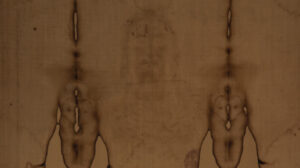
The Shroud bears a full-length frontal and dorsal1 negative imprint of a man’s body. The linen cloth, which is woven with a herringbone pattern, is approximately 4.3 meters long and 1.1 meters wide. The Shroud contains multiple blood and fluid stains as well as areas that have been burned and watermarked.
Supporters of the Shroud’s authenticity note that the blood splatters match those described in the Gospel accounts of Jesus’ crucifixion. They connect the blood wounds around the head, back, side, wrists, and feet on the cloth respectively with the placing of the crown of thorns on His head (John 19:2), the scourging of His back (Matthew 27:26; John 19:1), the piercing of His side (John 19:34), and the nailing of His hands and feet (John 20:25).
Scientific examinations by the Shroud of Turin Research Project (STURP)2 in 1978 revealed intriguing details, such as the presence of pollen allegedly predating the Byzantine period and first-century coins imaged in the eye sockets. Additionally, the Shroud’s herringbone weave is, according to Shroud advocates, similar to first-century burial cloths found in Jerusalem.
While significant passion and well-intentioned efforts have elevated the Shroud of Turin as a cornerstone of archaeological evidence for the death of Jesus, the artifact is fraught with many inconsistencies and unresolved issues. The dedication and hard work of those who have devoted their lives to substantiating the death, burial, and resurrection of Jesus are worthy of respect; however, the evidence supporting the Shroud fails on many levels, particularly in its alignment with both historical facts and biblical scriptures, undermining its credibility as an authentic relic.
Although many aspects could be examined in this brief discussion, the purpose of this article is not to diminish the beliefs of those who uphold the Shroud’s authenticity, but rather to highlight its vulnerabilities under critical scrutiny. This is especially true when considering the biblical discrepancies that remain inadequately addressed by its proponents and the Shroud’s late emergence in historical records.
Biblical Accounts
The biblical accounts of Jesus’ burial are of utmost importance in examining the validity of the Shroud of Turin. According to the Gospel accounts of Luke and John, Jesus was wrapped in more than one burial cloth.
Luke 24:12 (ESV)—But Peter rose and ran to the tomb; stooping and looking in, he saw the linen cloths (ὀθόνια) by themselves; and he went home marveling at what had happened.
John 20:5-7 (ESV)—And stooping to look in, he saw the linen cloths (ὀθόνια) lying there, but he did not go in. Then Simon Peter came, following him, and went into the tomb. He saw the linen cloths (ὀθόνια) lying there, and the face cloth (σουδάριον), which had been on Jesus’ head, not lying with the linen cloths (ὀθονίων) but folded up in a place by itself.
Note that John reports that a separate face cloth (σουδάριον) was folded and set aside from the burial cloths (ὀθονίων). The term “cloths” is translated from the Greek “τὰ ὀθόνια” (ta othonia). The word ὀθόνια in verses 5 and 6 of John 20 unequivocally means “strips of linen,” and the word used in verse 7 is also the plural form of the same Greek word, ὀθονίων, indicating multiple pieces of cloth. In short, John reports that Jesus’ body was wrapped in two different types of grave-cloths: a face cloth (σουδ΄άριον) and strips of linen (ὀθόνια).
John 11:11-45 describes Jesus’ resurrection of Lazarus involving two different burial clothing items, just like John 20:5-7. Verse 44 notes Lazarus’ appearance when he came forth from his grave: “The man who had died came out, his hands and feet bound with linen strips (κειρίαις), and his face wrapped with a cloth (σουδαρίῳ). Jesus said to them, ‘Unbind him, and let him go.’” Although the verse specifically mentions cloths wrapping only his hands, feet, and face, it is evident that Lazarus was wrapped in multiple cloths, similar to how Jesus was bound in John 20:7, where a separate cloth or napkin (σουδαρίῳ), was placed around His head.
Anointed with Spices
Some additional details in the biblical account may be valuable for studying the evidence of bloodstains on the Shroud. The Gospel of John mentions that a large quantity of spices were wrapped with Jesus’ burial garments:
Nicodemus also, who earlier had come to Jesus by night, came bringing a mixture of myrrh and aloes, about seventy-five pounds in weight. So they took the body of Jesus and bound it in linen cloths with the spices, as is the burial custom of the Jews (John 19:39-40).
Nicodemus provided approximately 75 pounds of myrrh and aloe, substances known for their strong adhesive properties. These spices were traditionally used in Jewish burial practices to anoint the body and help preserve it, likely creating a sticky and fragrant coating over the burial cloths.
The Shroud of Turin and the Biblical Accounts
Mathew 27:59, Mark 15:45-46, and Luke 23:53 all use the singular Greek word for fine linen cloth (σινδόνι), indicating that these Gospel writers described Jesus’ burial garments more generally than did John. Proponents of the Shroud’s authenticity argue that John may not have been correct in identifying two separate burial clothing items. Some have suggested that John’s reference to a separate face cloth may denote a simple binding strap, intended to secure the jaw in a closed position at death, in addition to the full-body linen shroud later identified as the Shroud of Turin.3
While this interpretation may seem to provide a possible solution to the textual problem for Shroud advocates, the notion that John was mistaken in his account regarding two separate burial cloths does not hold up under scrutiny for two reasons. First, John 20:7 notes that the σουδάριον (soudarion) was “folded up in a place by itself,” suggesting it was larger than just a strap for the jaw. Second, though Luke in his Gospel account (Luke 23:53) uses the singular Greek word for a fine linen cloth (σινδόνι), in the very next chapter, Luke uses the plural Greek word for linen cloths (ὀθόνια), identical to John 11 and 20, when describing Peter’s first glimpse into the tomb after Jesus’ resurrection (Luke 24:12).
Another theory proposed by scholars like Arnold Lemke is that the face cloth referred to by John was only used initially at the cross to wipe Jesus’ face and then set aside inside the tomb by an unknown burial attendant. Lemke summarizes this theory as follows:
It is also possible, of course, that there was in fact a true face cloth used for a brief time perhaps to help cover the head or face of our Lord while being taken on a carrier to the grave and then left there, with the main linen wrapping cloth later having been taken away from the grave by the time Peter arrived on Easter morning—but this is speculative.4
This view suggests that a genuine face cloth was briefly used to cover the head or face of Jesus at the grave or during His transport to the grave and was subsequently left inside the tomb while the main linen burial cloth was used to cover the body of Jesus. In other words, the face cloth would have been buried with the body but may not have remained on the face upon Jesus’ final interment. According to this view, the folded face cloth set aside from the burial garment was not folded or set aside by divine action, but by human agents.
Discussion on Biblical Accounts
To reconcile how the Shroud could have captured the complete image of Christ despite the clear indication in the biblical text of two distinct burial cloths, one must assert one of the following scenarios:
- Nicodemus did not actually apply 75 pounds of spices and aloes to Jesus’ body. This view discounts the explicit statement in John 19:39-40 where it states that “they took the body of Jesus and bound it in linen cloths with the spices.”
- The face covering was used in conjunction with the body shroud, covering the entire body without causing any disruption to the image of Jesus on the Shroud. However, John 20:7 specifically mentions “the face cloth, which had been on Jesus’ head, not lying with the linen cloths but folded up in a place by itself,” implying that this face cloth was separate from the larger body shroud.
- A single shroud was used to cover the face, head, and body without causing any smearing or distortion to the resulting image. This would require that the Shroud, with its precise image and unsmeared droplets of blood, was somehow applied without affecting the condition of Jesus’ blood and sweat, contradicting the realities of wrapping a recently crucified body in linen (as implied in John 20:6-7).
- John misrepresented the details, mistakenly describing two distinct clothing items, thereby suggesting that only one shroud covered the body from head to toe. This approach would essentially argue that the description in John 20:6-7 of two cloths is a gloss or error in the account.
- The second, folded face covering referenced by John and Luke was merely a thin linen strap used to close Jesus’ mouth. This theory disregards the textual implication in John 20:7 that it was a larger piece of cloth, “folded up in a place by itself,” suggesting that it was more substantial than a simple strap. Further complicating this theory is the lack of any clear evidence of a strap on the face depicted on the Shroud of Turin.
- The face covering referred to by John was merely a sweat cloth used immediately after Jesus was taken down from the cross but not applied within the tomb. This hypothesis, however, begs the question: why mention the napkin being folded in the tomb if it was not on Jesus when He was resurrected? This theory also relies on a human agent manipulating these burial cloths, rather than recognizing the possibility of divine action, as the biblical text seems to indicate.
Ultimately, all these scenarios challenge the clarity and authenticity of the text. They rely on arguments from silence or require reinterpretation of the text, which is clear in its description that two distinct burial cloths were used (Luke 24:12; John 20:5-7). John 20:6-7 indicates that when the tomb was found empty, the face cloth was folded neatly on the tomb bench, strongly suggesting that Jesus’ body was not stolen but that He had risen, leaving behind these items in an orderly manner, thus pointing to the resurrection.
In 1543, John Calvin presented a critical biblical rationale concerning burial cloths that remains relevant in comparing the Shroud of Turin with the biblical accounts:
In all the places where they pretend to have the graveclothes, they show a large piece of linen by which the whole body, including the head, was covered, and, accordingly, the figure exhibited is that of an entire body. But the Evangelist John relates that Christ was buried, “as is the manner of the Jews to bury.” What that manner was may be learned, not only from the Jews, by whom it is still observed, but also from their books, which explain what the ancient practice was. It was this: The body was wrapped up by itself as far as the shoulders, and then the head by itself was bound round with a napkin, tied by the four corners, into a knot…. On the whole, either the Evangelist John must have given a false account, or every one of them must be convicted of falsehood, thus making it manifest that they have too impudently imposed on the unlearned.5
If two linen garments (one for the face and one for the remainder of the body) were employed in the burial process, a single shroud could not encompass the entirety of the body and simultaneously capture a full and detailed image. Additionally, once again, the process of wrapping a body with linen, especially with the application of spices and aloes, would likely result in distortions, making it difficult to produce a clear and accurate representation of the entire form. The existence of the Shroud presents a clear contradiction with the descriptions provided by the biblical writers regarding Jesus’ burial garments, which imply a more complex arrangement that would not easily accommodate such an image under these conditions.
Dating the Shroud
On April 21, 1988, four samples were removed from the Shroud for analysis, each sample weighing approximately 50 mg and measuring 10×70 mm. It is important to note that the samples were taken from the main body of the Shroud, away from patches, but not necessarily far from the charred areas or obvious water stains. Three laboratories independently dated the Shroud to the Middle Ages,6 specifically between A.D. 1260 and 1390, rather than to the first century.7
Shroud advocates allege that of the 12 samples measured,8 there was a decrease in radiocarbon age as the samples were taken farther from the main body of the Shroud. In other words, samples taken closer to the area where the body lay were dated older, indicating less residual carbon-14 and therefore less modern contamination. Shroud proponents contend that the carbon dating results are flawed due to significant contamination by external sources of carbon-14, arguing that the Shroud dates to the first century.9 Possible contaminants include oils from human skin and soot from candles. Riani, et al.10 analyzed the samples measured by the three radiocarbon laboratories and concluded that the original sampling was flawed due to poor experimental design. Casabianca, et al. noted the following:
The measurements made by the three laboratories on the Shroud sample suffer from a lack of precision which seriously affects the reliability of the 95% CE 1260-1390 interval. The statistical analyses, supported by the foreign material found by the laboratories, show the necessity of a new radiocarbon dating to compute a new reliable interval…. Without this re-analysis, it is not possible to affirm that the 1988 radiocarbon dating offers “conclusive evidence” that the calendar age range is accurate and representative of the whole cloth.11
However, according to Dr. Harry Gove, who developed AMS technology and observed the Shroud’s dating process in the Arizona lab, if the Shroud were truly from the first century and the results were skewed by contamination, the samples tested would have needed to be contaminated to the extent that one-third of the entire sample was affected—something that is highly improbable.12
Textile Analysis
In 1988, during the extraction of the radiocarbon sample, the Shroud underwent a comprehensive examination by Gabriel Vial, the Technical General Secretary of the Centre International d’Étude des Textiles Anciens (CIETA). Vial determined that the Shroud had been produced on a four-shaft treadle loom.13 The distinctive herringbone pattern of the Shroud can be characterized by its V-shaped formations. Across the width of the Shroud, there are 53.5 of these V-shapes, each comprising approximately 80 warp threads—40 slanting in one direction and 40 in the opposite. This intricate pattern is achieved by sequentially attaching the threads to four shafts in a specific order: 1-2-3-4, repeated 40 times, followed by 3-2-1-4, also repeated 40 times, and continuing this sequence across the entire width of the Shroud. Accomplishing this with around 4,300 threads to produce 53.5 complete V-shapes is a highly skilled task.14 The evidence points unmistakably to the Shroud being woven on a four-shaft loom, likely operated by heddles. No such loom or weaving technique is known to have existed in the first-century Middle East, where silk production using similar technology was confined to China.
Vial expresses some skepticism toward claims that similar textiles had been discovered from ancient periods. Vial explains:
So far every example studied—and these have come from Pompeii, Antinoe, Palmyra, Cologne, Dura-Europos—has been radically different from the shroud, both from the point of view of the structure (2/2 twill as opposed to 3/1) and the materials used (wool and silk rather than linen). We have to look to the 16th century to find the first example of linen chevron weaving with a 3/1 twill structure, found in the canvas of a painting in Herentals (Belgium). Taking into account the constituent elements of any textile (material, structure, warp and weft density), the textile of which the shroud is composed is unlike anything presently known to date prior to the 16th century.15
Although Vial refrains from assigning a precise date to the Shroud’s origin, he contends that the four-shaft loom responsible for the Shroud’s distinctive 3/1 herringbone weave likely did not exist until the late medieval period. Supporting this, Hugh Farey states, “The conclusion to all this is clear, and difficult to obfuscate. The Shroud was inescapably woven on a four-shaft loom, and most probably one operated by heddles. Nothing of the kind is found, illustrated, or mentioned around the 1st century Middle East, and silk production involving such a loom was restricted to China. The Shroud, however, was made in Northern Europe, in the late 13th century, by which time the appropriate apparatus was established.”16
The Bloodstains
After His arrest and appearance before Pilate, Jesus would have been severely wounded, covered in blood during the journey to Golgotha (John 19:1; Mark 15:15; Matthew 27:29–31). The Gospel accounts, specifically John 20:25 and Luke 24:39-40, indicate that Jesus’ hands and feet were nailed to the cross. Additionally, the soldiers pierced Jesus’ side (John 19:34). Sure enough, bloodstains correspond to these areas on the Shroud.
Real Blood?
Despite years of debate on whether the stains on the Shroud constitute actual blood, little consensus has been achieved. While some experts have rejected the notion that the stains on the Shroud of Turin are actual blood,17 there are those who, despite doubting the Shroud’s authenticity, acknowledge the presence of blood.18 Scholars like Hugh Farey argue that blood may have been used to enhance or embellish the artistic depiction of a man in repose.
Whether the stains are genuine blood, paint, or a combination of both, the limited studies conducted on the Shroud have primarily analyzed samples that had been cleaned of any adherent particles, often with differing methodologies, resulting in inconsistent conclusions. Walter McCrone19 analyzed approximately 30 sticky tape slides taken from various sections of the Shroud of Turin and identified small orange-red particles on numerous fibers, which he recognized as an iron oxide pigment. By assessing the density of these particles, he could distinguish between image and non-image areas, leading him to conclude that the image on the Shroud was at least partially created by iron oxide paint.20
In contrast, John Heller and Alan Adler21 examined about 20 of the same slides but did not report observing a significant presence of these orange-red particles or their differential distribution. Heller and Adler, however, used a different approach. Instead of direct microscopic examination, they extracted individual fibers with toluene, thoroughly rinsing them to remove the sticky tape glue. This process likely also removed any paint medium and most of the embedded pigment. The discrepancies between McCrone’s and Heller and Adler’s findings likely stem from these differing methodologies rather than any intentional misrepresentation.22 Understanding these experimental differences offers a more balanced explanation for the conflicting results.
Heller and Adler concluded that the blood predates the image on the cloth.23 Their research suggested that since the image fibers exhibited “corrosion” while the blood-covered areas did not, the image must not exist beneath the blood. However, this conclusion does not consider the potential effects of the blood or serum on the image at the time of application or during subsequent removal. The evidence suggesting that the blood predates the image is not definitive and may overlook key factors.
This raises the possibility that the blood and image could have been created simultaneously or that the blood was even added afterward as part of an artistic process. The Shroud clearly was carefully crafted to simulate the appearance of a burial cloth, using techniques that might enhance its credibility as a holy relic. The ambiguity surrounding the timing of the blood application lends credence to the theory that the Shroud may have been purposefully designed as a devotional or symbolic piece rather than an authentic witness to a Jesus burial (or anyone in the first century).
Flow Patterns and Scourge Marks
Upon evaluating the bloodstains on the Shroud, the distinct flow patterns have sparked considerable debate regarding their authenticity. Among the chief concerns are the marks on the back and legs of the Shroud image that are supposed to represent the injuries incurred through the scourging of Jesus. It is well known that scourging was designed to inflict pain and bodily injury through the tearing of flesh.
It is unknown what type of flagrum was utilized in the scourging of Jesus. However, if wounds were inflicted that would abrade and tear the skin (as most often depicted), significant blood flow would occur with each strike (John 19:1). Shroud advocates maintain that these continually oozing injuries would remain moist for hours and would eventually allow for the transfer of the scourge wounds to the cloth. However, according to Farey, there is no sign of any “flow” on the Shroud from the scourge marks on the back, let alone “areas of torn skin [which] would ooze blood and clear body fluid (serum).”24
Matteo Borrini and Luigi Garlaschelli forensically analyzed the blood patterns from the Shroud. They found that the blood flow patterns observed on the arms and legs of the figure depicted in the Shroud do not align with the expected behavior of blood from a man who had been crucified with his arms positioned at an approximate 45-degree angle. Specifically, the blood rivulets on the back of the left hand correspond to a position in which the arms are extended 35 to 45 degrees above horizontal. Conversely, the bloodstains on the forearm suggest a scenario in which the hands were positioned almost vertically. In such a case, the blood would flow directly down the forearm, rather than at an angle, which is inconsistent with the blood patterns shown on the Shroud. The authors of the study note, “Assuming that the red stains on the Turin linen are actually blood from the crucifixion wounds, the results of the experiments demonstrate that the alleged flowing patterns from different areas of the body are not consistent with each other.”25
Nicolotti26 has observed that the marks on the body depicted in the Shroud correspond precisely with the shape of scourges known to people in the Middle Ages and commonly represented by artists of that period. Nicolotti maintains that the scourge marks are further evidence for dating the Shroud around the Middle Ages, specifically, in the first half of the fourteenth century.
Washed or Unwashed?
Whether Jesus’ body was washed or remained unwashed after His crucifixion is a crucial issue in determining the authenticity of the Shroud of Turin. While many have weighed in on this matter, examining the blood spatter, the angle of the wrist stain, and the distinct divergence of the streams, little consensus has emerged.27
Some advocates28 argue that Jesus’ body was washed before burial and that the stains on the Shroud came from blood that flowed from the wounds after Jesus was laid to rest. This hypothesis requires the assumption that the wounds continued to bleed significantly after death. However, medically speaking, dead bodies do not continue to bleed after death. Once the heart stops, blood pressure drops to zero, halting active bleeding. While gravity may cause some passive leakage from wounds, significant blood flow ceases immediately. Blood also coagulates shortly after death, preventing any meaningful post-mortem bleeding. Medical literature confirms that post-mortem bleeding is typically minimal and does not result in the flowing patterns seen in living bodies.29
Those who advocate that Jesus’ body remained unwashed when placed in the tomb30 must assume that, despite being removed from the cross, transported to the tomb, and wrapped in a linen shroud with a large quantity of spices, the bloodstains remained precisely defined without smearing.
Discussion on Bloodstains
Interpreting the bloodstain patterns on the Shroud of Turin is fraught with significant limitations. Current analysis relies solely on photographs, lacking direct examination of the cloth itself. Even if the blood stains from the Shroud represent real blood, this fact does not specify whether the blood was human nor a person from the first century.31 Furthermore, there is still insufficient scientifically verified information about the cloth’s history over the past 2,000 years to draw definitive conclusions. As Jumper, et al. rightly note, science is not in a position to categorically prove the Shroud’s authenticity as the burial cloth of Jesus,32 which underscores the inherent uncertainty and challenges in attempting to interpret the bloodstains on the Shroud.
Given the cessation of active bleeding after death, it is highly improbable that the detailed blood patterns on the Shroud of Turin could have been produced by a natural interaction between the burial cloth and a dead body. In an attempt to reconcile the presence of detailed bloodstains on the Shroud with the biblical account of Jesus’ burial, some proponents have suggested various theories33 to explain how dried blood could have become re-liquefied and transferred to the linen cloth. These speculative hypotheses underscore the difficulty—if not futility—of trying to justify the detailed blood patterns observed on the Shroud as being naturally produced by a corpse post-crucifixion. The need for such elaborate explanations only highlights the implausibility of these claims.
Moreover, again, the spices mentioned specifically in John 19:39-40 would have significantly impacted the condition of the skin and any blood present on it, likely absorbing or smearing the blood, preventing the creation of the sharp, well-defined rivulets depicted on the Shroud.34 Yet, modern scientific analysis has found no trace of these sticky, resinous materials on the Shroud.35 The absence of any spice residue undermines the claim that the Shroud is the authentic burial cloth of Jesus, as it contradicts the details provided in the Gospel and the burial practices of the time.
Endnotes
1 The frontal image refers to the anterior or front portion of the man’s body: face, chest, etc., whereas the dorsal image refers to the posterior or back plane of the body.
2 STURP was a comprehensive study of the Shroud of Turin conducted by American scientists in 1978. The project was led by John Jackson, a physics professor at the Air Force Academy, after he discovered in 1975 that the Shroud’s images contained 3D information. With permission from the Shroud’s owner and church authorities, the scientists performed nondestructive experiments on the Shroud for 120 hours, including light and electron microscopy, photography, UV spectrophotometry, X-ray fluorescence, and thermal photography.
3 Vignon is one of the early researchers who proposed that the image of Jesus’ beard on the Shroud appears to be pressed or distorted, possibly due to a jaw strap. See Paul Vignon (1939), The Shroud of Christ (Westminster: Archibald Constable). Ian Wilson also makes reference to some distortion of the beard of Jesus portrayed in the Shroud as potentially created by a jaw strap. See Ian Wilson (2010), In The Shroud: The 2000-Year-Old Mystery Solved (New York: Doubleday).
4 Arnold E. Lemke (2000), “The Shroud of Turin—Is it or Isn’t it the Burial Cloth of Christ?” Paper presented at the St. Croix Pastor, Teacher, Delegate Conference, 6.
5 John Calvin (1844), “An Admonition Showing the Advantages which Christendom Might Derive from an Inventory of Relics,” trans. Henry Beveridge (Calvin Translation Society) pp. 332-334.
6 The C-14 dating protocol employed in dating the Shroud was thorough and designed to remove the claim of bias from having four samples delivered to three independent laboratories with three control samples.
7 P.E. Damon, et al. (1989), “Radiocarbon Dating of the Shroud of Turin,” Nature, 337:611-615.
8 The four samples were submitted to three independent accelerator-mass-spectrometry (AMS) laboratories in Tucson, Arizona; Oxford, England; and Zurich, Switzerland. For verification purposes, three control samples were included: (1) a linen piece from a Nubian tomb dating to the eleventh or twelfth century, (2) a linen cloth from a mummy associated with Cleopatra of Thebes, dating to the early second century, and (3) threads extracted from the cope (a ceremonial outer garment) of St. Louis d’Anjou from the Basilica of Saint-Maximin, France, dating to the early thirteenth century. Table 1 presents the age results as published in Nature. Following rigorous calibration, the radiocarbon analysis of the Shroud indicated a date range between A.D. 1260 and 1390. Significantly, the dates obtained for the control samples aligned appropriately with their anticipated historical periods (P.E. Damon, et al.).
9 Note that radiocarbon dating does, in fact, sometimes result in ages of materials that exceed 10,000 years. Radiocarbon dating, however, is understood to be suspect for objects thought to be older than roughly 3,000-4,000 years old [cf. George H. Michaels and Brian Fagan (2013), “Chronological Methods 8—Radiocarbon Dating,” University of California Santa Barbara Instructional Development.]. Further, biblical creationists argue that radioactive decay rates were apparently accelerated during the Flood and afterward, possibly up to 1,500-1,000 B.C., making all dating techniques unreliable for ages beyond that time. For evidence of accelerated radioactive decay in the past, see Don DeYoung (2008), Thousands…Not Billions (Green Forest, AR: Master Books).
10 M. Riani, et al. (2013), “Regression Analysis with Partially Labelled Regressors: Carbon Dating of the Shroud of Turin,” Statistics and Computing, 23:551-561.
11 T. Casabianca, et al. (2019), “Radiocarbon Dating of the Turin Shroud: New Evidence from Raw Data,” Archaeometry, 61[5]:1223-1231, March 22.
12 H.E. Gove (1996), Relic, Icon or Hoax? Carbon Dating the Turin Shroud (Bristol, UK: Institute of Physics Publishing, Techno House), pp. 291-292.
13 Gabriel Vial (1990), “Shrouded in Mystery,” HALI: The International Magazine of Fine Carpets and Textiles, p. 49.
14 Ibid.; See also Hugh Farey (2018), The Medieval Shroud: The Beginning of an Exploration into its Purpose, Process and Provenance, p. 17; Hugh Farey (2019), The Medieval Shroud 2: No Case for Authenticity, p. 20.
15 Vial, p. 49.
16 Hugh Farey (2019), “The Medieval Weave.” Medieval Shroud, September 13, https://medievalshroud.com/the-medieval-weave/.
17 Walter McCrone (1981), “Light-Microscopical Study of the Turin Shroud III,” The Microscope 29:19-38; Walter McCrone (1990), “The Shroud of Turin: Blood or Artist’s Pigment?” Accounts of Chemical Research, 23[3]:77-83.
18 Hugh Farey (2020), “The Medieval Shroud,” Science, Theology and the Holy Shroud, Edited Papers from the 2019 International Conference on the Turin Shroud, ed. R. Gary Chiang and Evelyn M. White (Ancaster, Ontario: Doorway Publications), pp. 1-7.
19 McCrone (1981); McCrone (1990).
20 McCrone documented his findings with photographs, which were later supported by Eugene Nitowski and Joseph Kohlbeck, who also photographed the sticky tapes, showing orange-red particles adhering to the fibers, though they did not quantify or differentiate them based on image areas.
21 John H. Heller and A.D. Adler (1981), “A Chemical Investigation of the Shroud of Turin,” Canadian Society of Forensic Science Journal, 14[3]:81-103; John H. Heller (1983), Report on the Shroud of Turin (Boston: Houghton Mifflin); John H. Heller and A.D. Adler (1980), “Blood on the Shroud of Turin,” Applied Optics, 19[16]:2742-2744.
22 Heimburger, a medical doctor with an interest in the Shroud of Turin, authored “A Detailed Critical Review of the Chemical Studies on the Turin Shroud: Facts and Interpretations” (2008), https://www.shroud.com/pdfs/thibault%20final%2001.pdf. Additionally, David Ford provides insightful analyses of the debate between McCrone/Nickell and Heller/Adler in his work titled, “The Shroud of Turin’s ‘Blood’ Images: Blood, or Paint? A History of Science Inquiry” (2000), which can be accessed at www.shroud.com/pdfs/ford1.pdf.
23 Heller and Adler (1981), 14[3]:81-103.
24 See Hugh Farey (2023), “Book Review: The Shroud of Jesus,” https://medievalshroud.com/book-review-the-shroud-of-jesus/.
25 M. Borrini and L. Garlaschelli (2019), “A BPA approach to the Shroud of Turin,” Journal of Forensic Science, 64[1]:137-143.
26 Andrea Nicolotti (2024), “The Scourge of Jesus and the Roman Scourge: Historical and Archaeological Evidence,” For the Study of the Historical Jesus, 15[1]:57; Andrea Nicolotti (2015), Storia e Leggende di una Reliquia Controversa (Turin: Einaudi); Andrea Nicolotti (2016), “La Sindone, Banco di Prova per Esegesi, Storia, Scienza e Teologia,” Annali di Storia Dell’esegesi, 33[2]:459-510.
27 See A. Heger, et al. (2024), “Further Experiments and Remarks Regarding the Possible Formation of Blood Stains on the Turin Shroud: Stains Attributed to the Nailing of the Hands,” International Journal of Legal Medicine, 138:1573-1581.
28 See Frank C. Tribbe (2006), Portrait of Jesus? The Shroud of Turin in Science and History, 2nd ed. (St. Paul, MN: Paragon House); also F.T. Zugibe (2005), The Crucifixion of Jesus: A Forensic Inquiry (New York: M. Evans & Co.), p. 219.
29 Robert A. Wild, “The Shroud of Turin—Probably the Work of a 14th-Century Artist or Forger,” Biblical Archaeology Review, 10[2]:30-46; Joris Meurs (2023), “Immediate Postmortem Changes,” Encyclopedia of Forensic Sciences, 3:218-223.
30 I. Wilson (1998), The Blood and the Shroud: New Evidence that the World’s Most Sacred Relic is Real (New York: Simon & Schuster), p. 32.
31 Kelly P. Kearse (2020), “Unanticipated Issues in Serological Analysis of Blood Species: The Shroud of Turin as a Case Example,” Forensic Science International: Reports, Vol. 2.
32 E.J. Jumper, et al. (1984), “A Comprehensive Examination of the Various Stains and Images on the Shroud of Turin,” ed. J.B. Lambert, in Archaeological Chemistry-III, Advances in Chemistry Series 205 (Washington DC: American Chemical Society), pp. 447-476.
33 König, L., et al. “Some Experiments,” 229-238.
34 G.R. Lavoie, et al. (1983), “Blood on the Shroud of Turin: Part II—The Importance of Time in the Transfer of Blood Clots to Cloth as Distinctive Clot Images,” Shroud Spectrum International, 8:2-10; L. König, et al. (2024), “Some Experiments and Remarks Regarding the Possible Formation of Blood Stains on the Turin Shroud: Stains Attributed to the Crown of Thorns, the Lance Wound and the Belt of Blood,” International Journal of Legal Medicine, 138:229-238.
35 Raymond E. Brown (1994), The Death of the Messiah: From Gethsemane to the Grave: A Commentary on the Passion Narratives in the Four Gospels, vol. 2 (New York: Doubleday); David Noel Freedman (1992), The Anchor Yale Bible Dictionary, vol. 1 (New Haven, CT: Yale University Press).

REPRODUCTION & DISCLAIMERS: We are happy to grant permission for this article to be reproduced in part or in its entirety, as long as our stipulations are observed.
posted by Believer | 1:00 AM

0 Comments:
Post a Comment
<< Home